From Postman to Production Flow: Testing a Cross-Border Transfer End-to-End
Table of contents
- The flow, at a glance
- Collection Variables
- Step 1: Get Profiles
- Step 2: Create Quote (SGD → GBP)
- Step 3: Retrieve Recipient Account
- Step 4: Create Transfer
- Step 5: Fund Transfer from Balance
- Step 5b: Get Transfer Status
- Step 6: Cross-checking against the Wise console UI
- Step 7: Trying to push the transfer to a terminal state
- Summary
In the previous post I covered the theory behind cross-border payments: SWIFT, local rails, FX rates, and where compliance sits in the flow. This post is where I actually put that understanding to work. I built a Postman collection against Wise Platform’s sandbox and ran a real SGD → GBP transfer end to end, capturing every request, response, and webhook along the way.
This isn’t a “here’s what the docs say happens” post. Every ID, rate, and screenshot below came from an actual run.
Environment: Wise Sandbox V1 (https://api.sandbox.transferwise.tech) Flow: SGD → GBP, BALANCE payIn, BANK_TRANSFER payOut Tool: Postman, custom-built collection with post-response scripts auto-capturing IDs into collection variables
The flow, at a glance
sequenceDiagram
    participant P as Partner / Postman
    participant W as Wise API
    participant B as Recipient Bank

    P->>W: GET /v1/profiles
    W-->>P: profileId = 30565011 (business)

    P->>W: POST /v3/profiles/30565011/quotes
    W-->>P: quoteId, rate, expirationTime

    P->>W: GET /v1/accounts?profile=30565011
    W-->>P: recipientAccountId

    P->>W: POST /v1/transfers
    W-->>P: transferId, status: incoming_payment_waiting
    W--)P: webhook: transfers#state-change (incoming_payment_waiting)

    P->>W: POST /v3/profiles/30565011/transfers/{id}/payments
    W-->>P: payment COMPLETED, status: processing
    W--)P: webhook: transfers#state-change (processing)

    W->>B: (would deliver GBP -- blocked at simulation, see below)
Every step produces an ID the next step consumes. Here’s each one, with the actual response captured.
Collection Variables
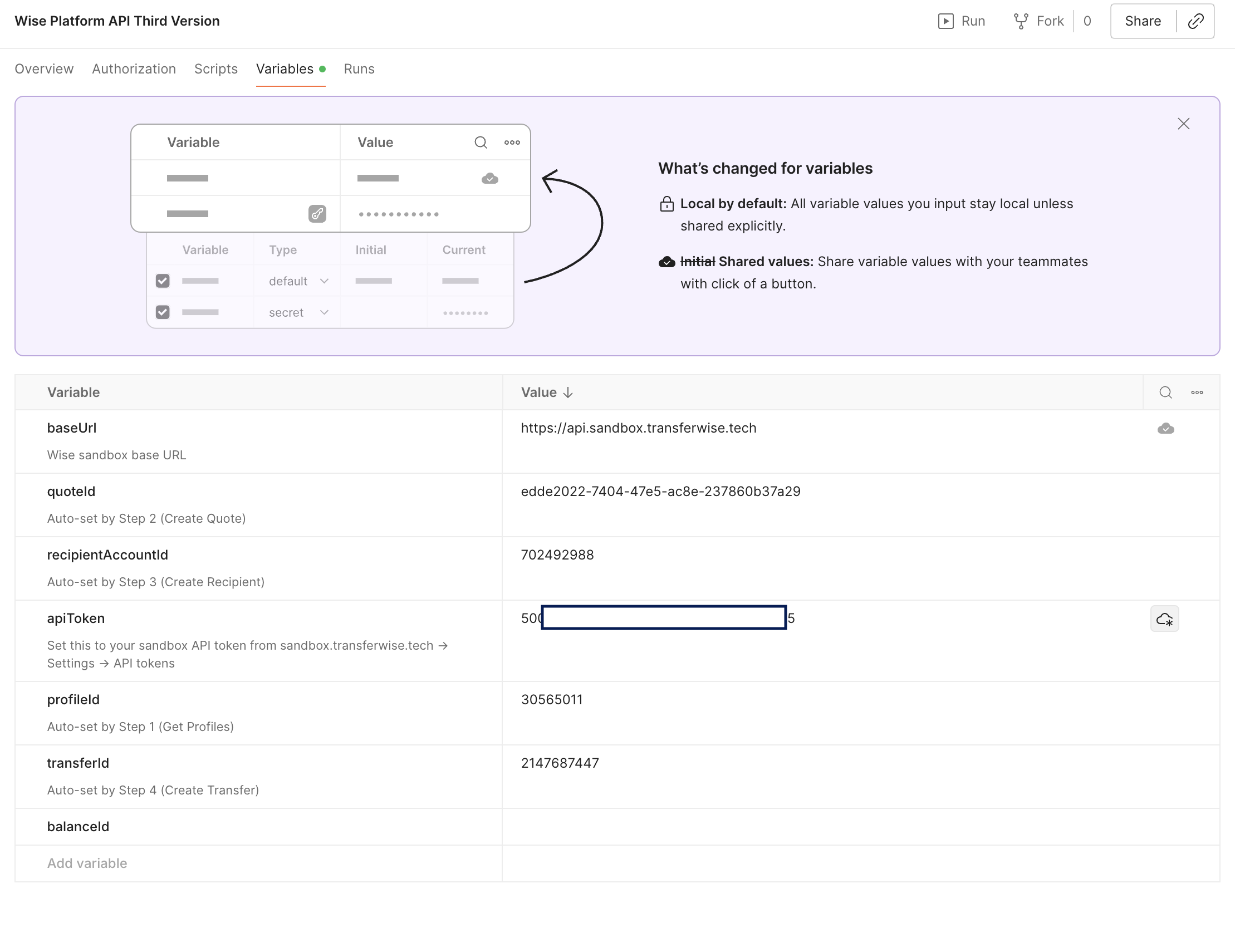
| Variable | Value | Set by |
|---|---|---|
baseUrl | https://api.sandbox.transferwise.tech | Manual |
profileId | 30565011 | Step 1 |
quoteId | edde2022-7404-47e5-ac8e-237860b37a29 | Step 2 |
recipientAccountId | 702492988 | Step 3 |
transferId | 2147687447 | Step 4 |
apiToken | (masked) | Manual |
Step 1: Get Profiles
GET /v1/profiles/
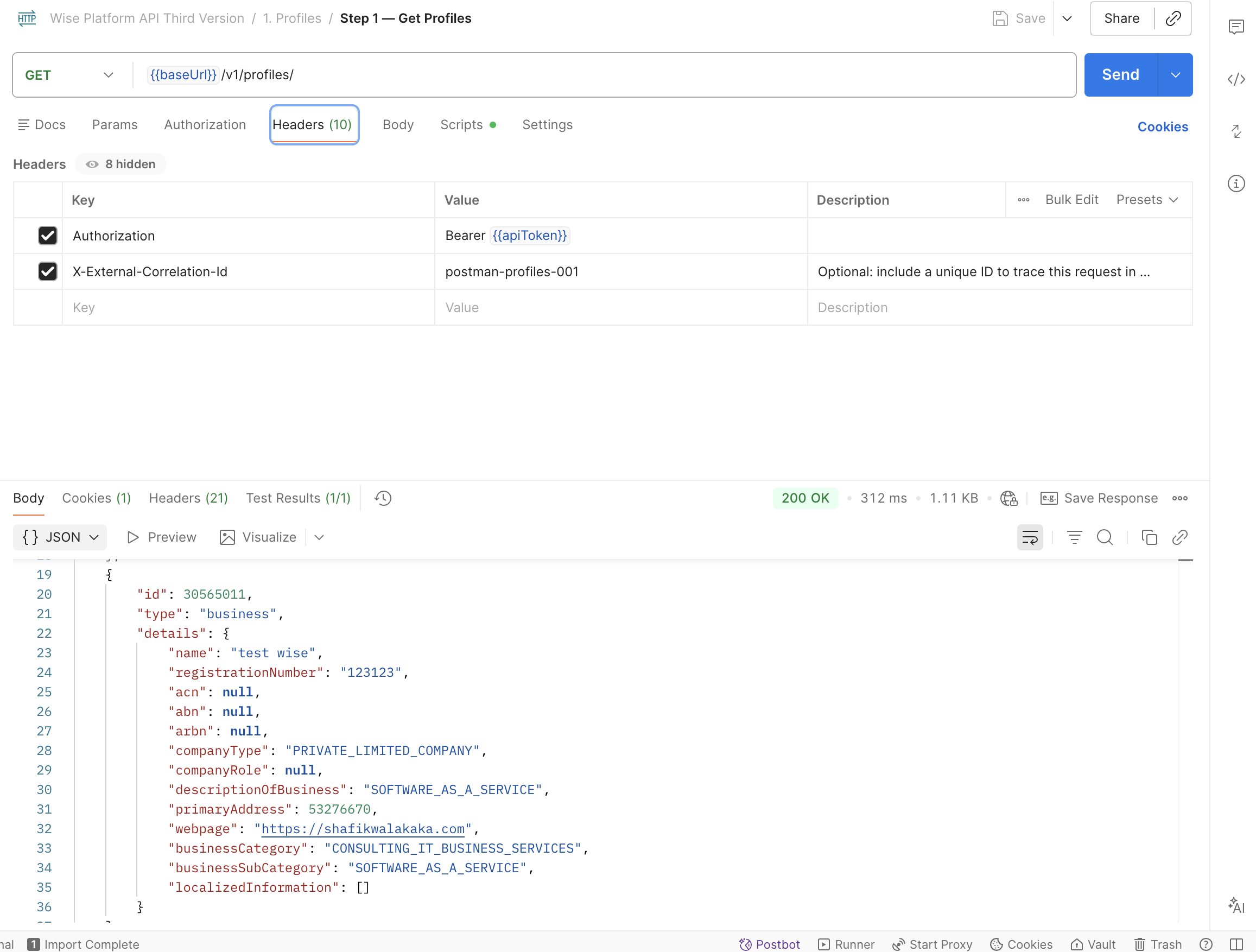
200 OK (312ms). A post-response script selects the type: "business" profile and sets {{profileId}} = 30565011.
Step 2: Create Quote (SGD → GBP)
POST /v3/profiles/{{profileId}}/quotes
{
  "sourceCurrency": "SGD",
  "targetCurrency": "GBP",
  "sourceAmount": 200,
  "payOut": "BANK_TRANSFER"
}
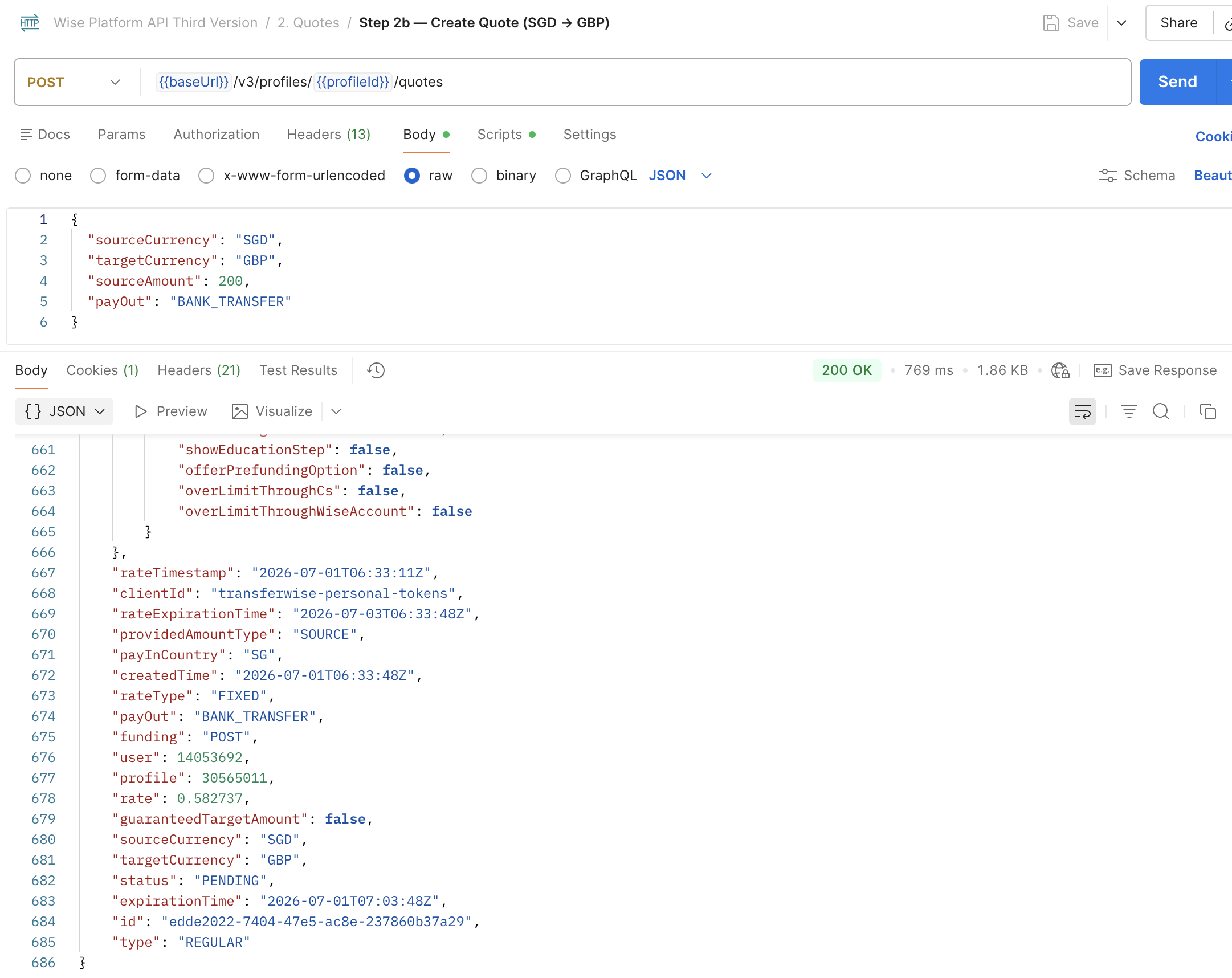
200 OK (769ms)
| Field | Value | Notes |
|---|---|---|
id | edde2022-7404-47e5-ac8e-237860b37a29 | Set as {{quoteId}} |
rate | 0.582737 | Locked SGD/GBP rate |
expirationTime | 2026-07-01T07:03:48Z | 30-minute window to create the transfer |
status | PENDING | Quote is live |
Step 3: Retrieve Recipient Account
GET /v1/accounts?profile={{profileId}}
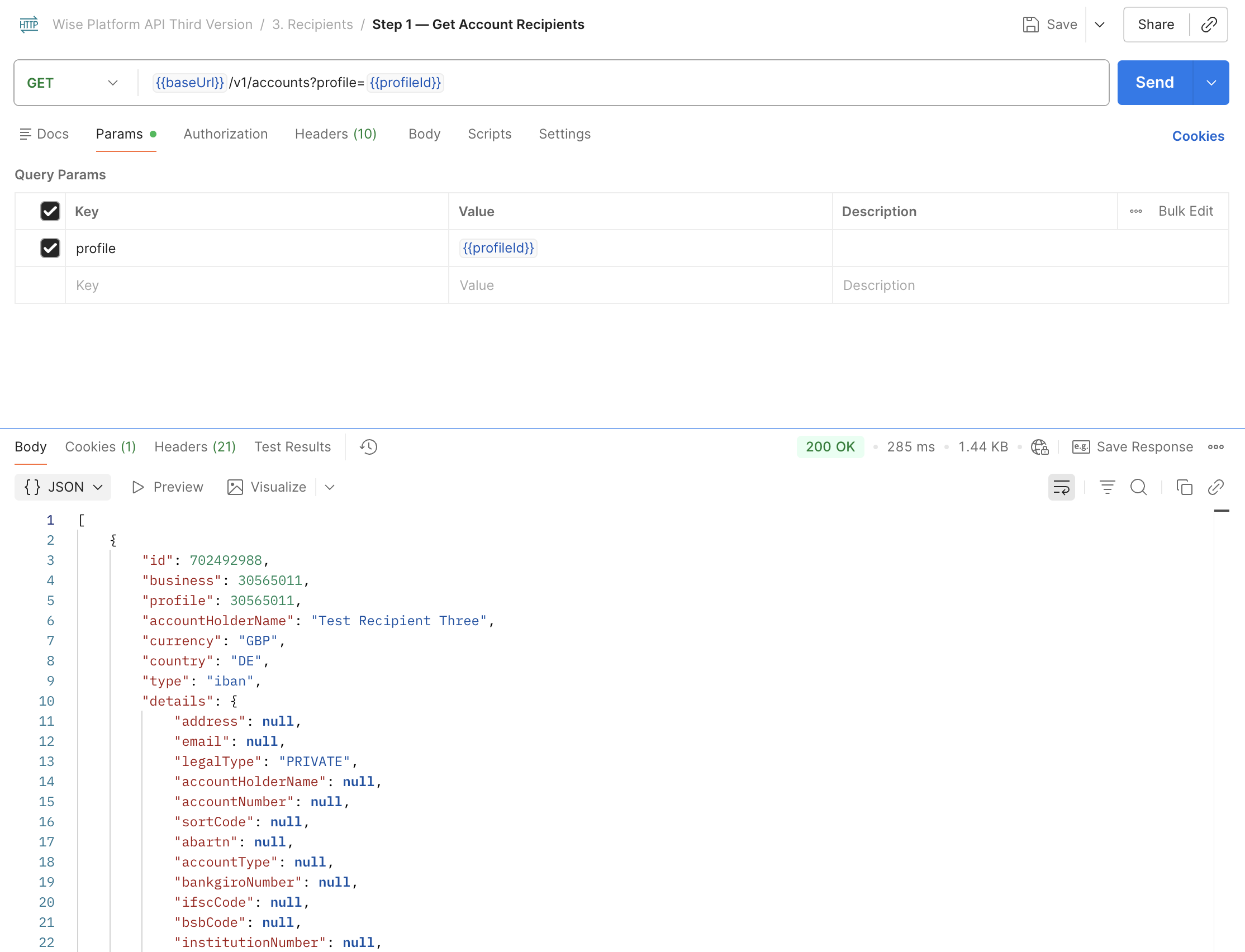
200 OK (285ms) – an existing GBP recipient is retrieved and reused.
| Field | Value |
|---|---|
id | 702492988 |
accountHolderName | Test Recipient Three |
currency | GBP |
Step 4: Create Transfer
POST /v1/transfers
{
  "targetAccount": {{recipientAccountId}},
  "quoteUuid": "{{quoteId}}",
  "customerTransactionId": "{{$guid}}",
  "details": {
    "reference": "TestTransfer"
  }
}
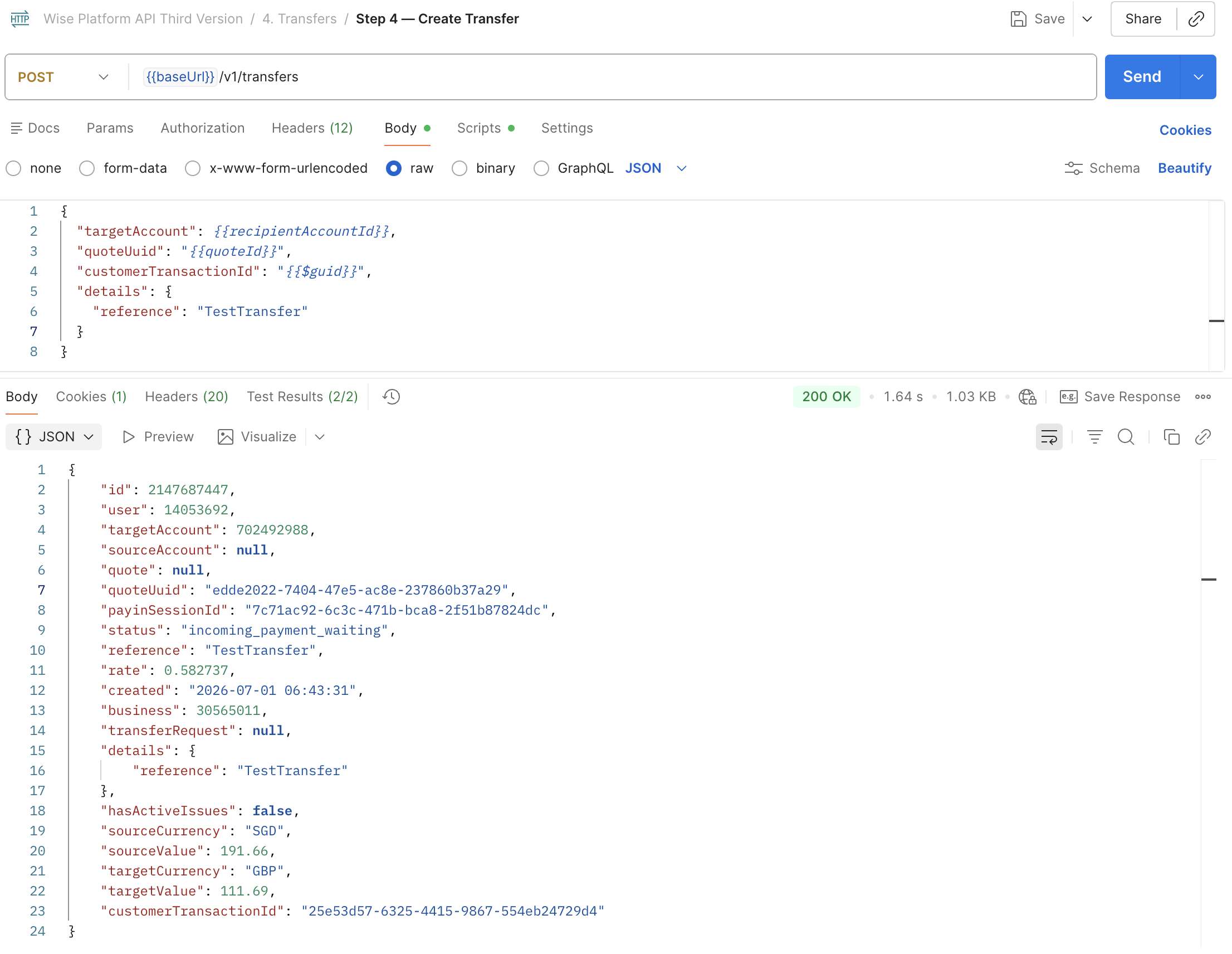
200 OK (1.64s)
| Field | Value | Notes |
|---|---|---|
id | 2147687447 | Set as {{transferId}} |
status | incoming_payment_waiting | Expected initial state |
customerTransactionId | 25e53d57-6325-4415-9867-554eb24729d4 | Auto-generated GUID |
customerTransactionId is an idempotency key. If the create-transfer request fails mid-flight (dropped connection, timeout), retrying with the exact same customerTransactionId and payload returns the original transfer rather than creating a duplicate. I verified this behavior directly in the next post.
Webhook: incoming_payment_waiting
Transfer creation triggers an immediate transfers#state-change webhook to the registered callback endpoint (webhook.site, used as a public HTTPS receiver for sandbox testing).
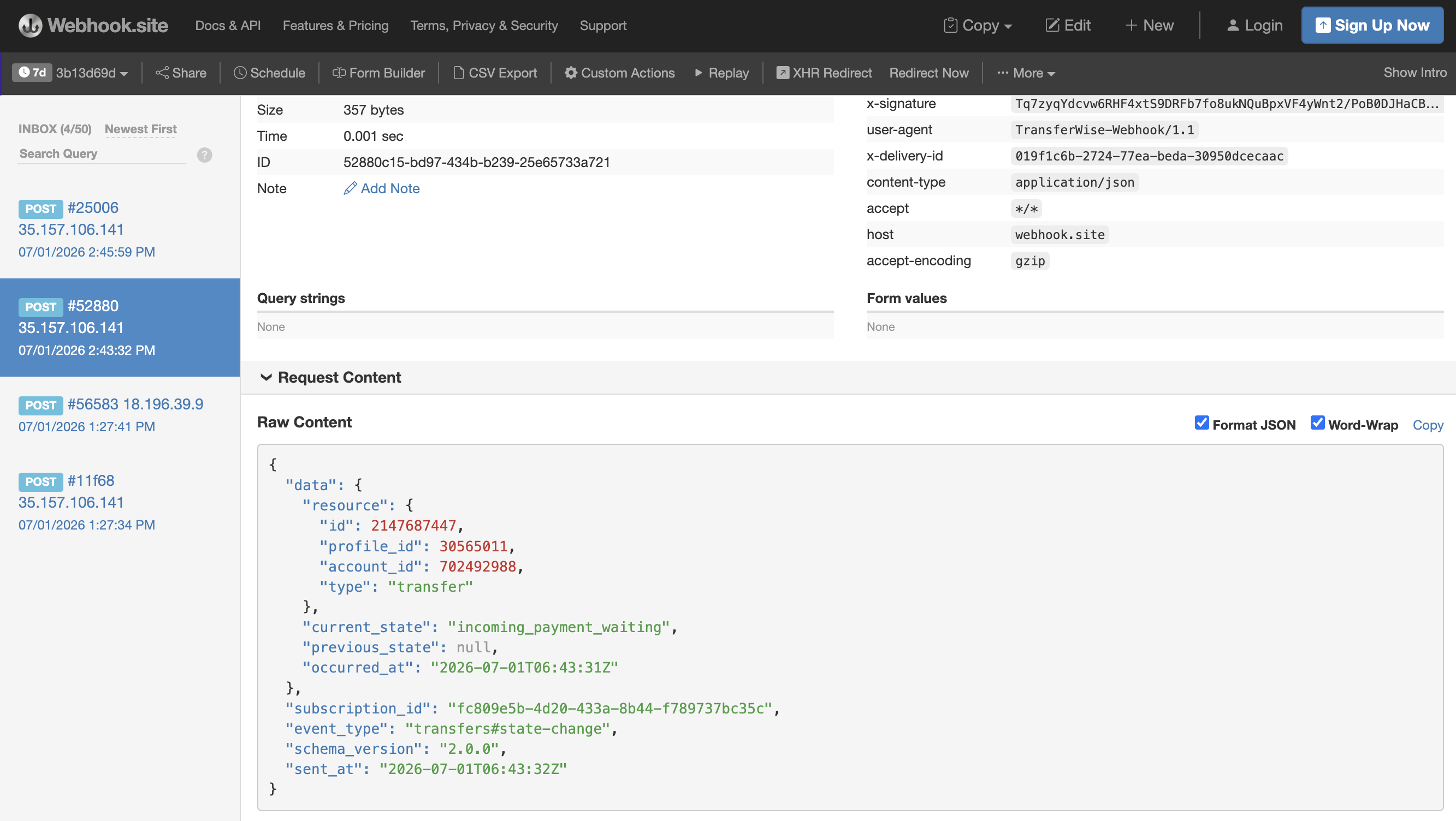
{
  "data": {
    "resource": {
      "id": 2147687447,
      "profile_id": 30565811,
      "account_id": 702492988,
      "type": "transfer"
    },
    "current_state": "incoming_payment_waiting",
    "previous_state": null,
    "occurred_at": "2026-07-01T06:43:31Z"
  },
  "event_type": "transfers#state-change",
  "schema_version": "2.0.0",
  "sent_at": "2026-07-01T06:43:32Z"
}
All four resource fields are present here (id, profile_id, account_id, type), and sent_at is a sensible one second after occurred_at. I’m calling this out specifically because in a separate exercise analyzing a deliberately-broken sample payload, both of those things were wrong – profile_id/account_id were missing and sent_at preceded occurred_at by 10 days. Seeing a clean, correctly-ordered webhook here gave me something real to contrast that broken sample against.
Step 5: Fund Transfer from Balance
POST /v3/profiles/{{profileId}}/transfers/{{transferId}}/payments
{
  "type": "BALANCE"
}
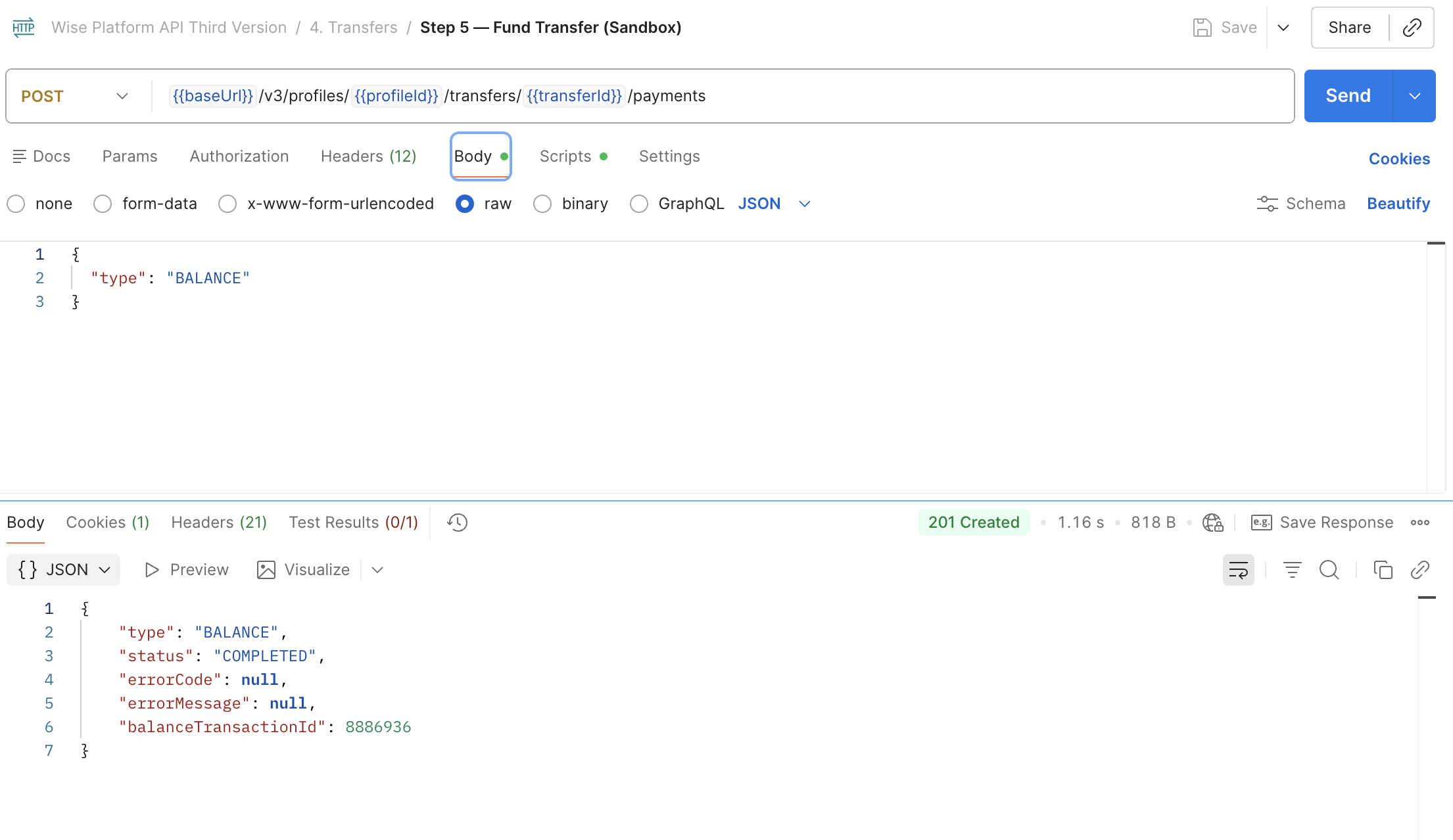
201 Created (1.16s). Before this call, the SGD balance was topped up via POST /v1/simulation/balance/topup – a sandbox-only endpoint with no production equivalent.
| Field | Value |
|---|---|
type | BALANCE |
status | COMPLETED |
balanceTransactionId | 8886936 |
Step 5b: Get Transfer Status
GET /v1/transfers/{{transferId}}
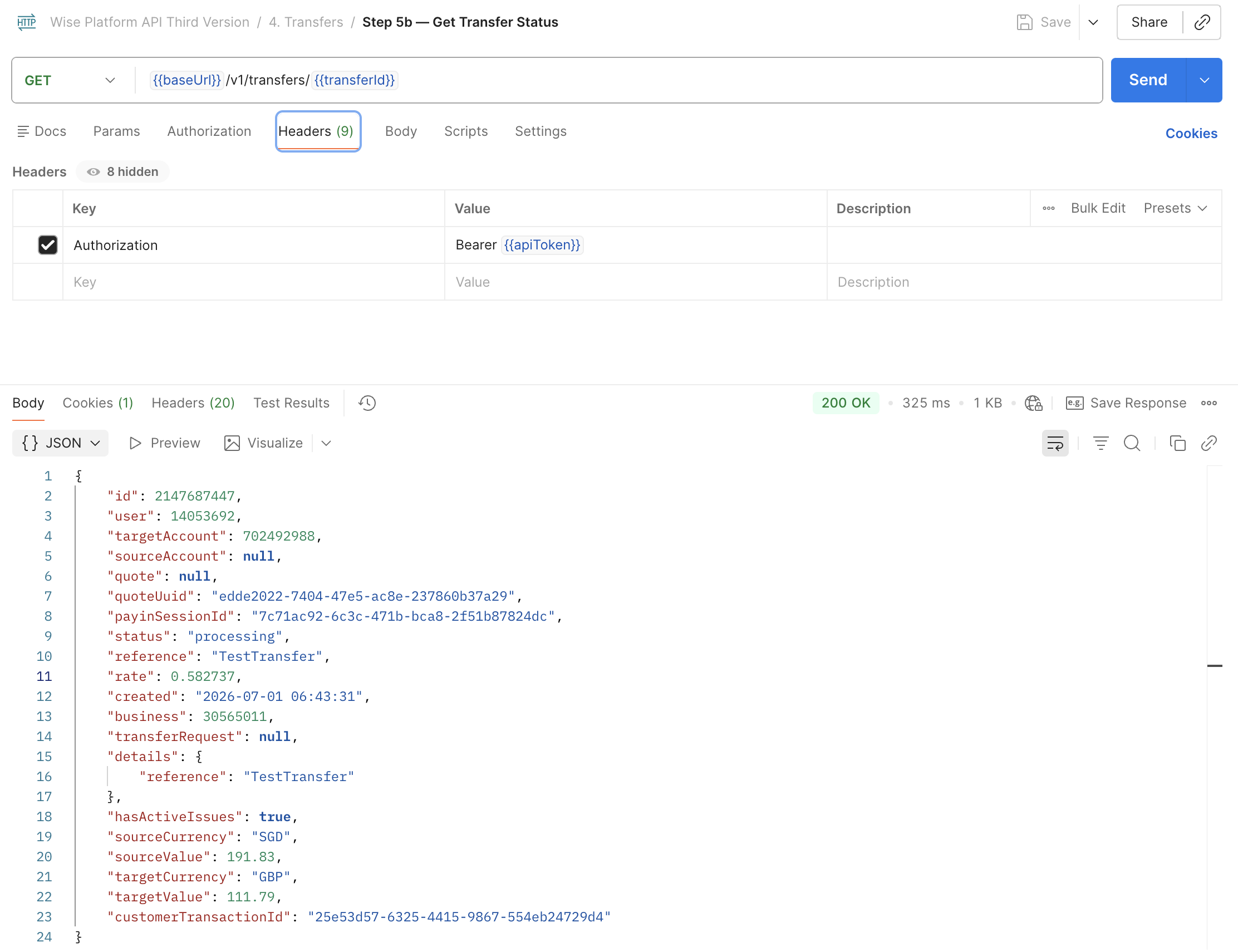
200 OK (325ms)
| Field | Value |
|---|---|
status | processing |
sourceValue | 191.83 SGD |
targetValue | 111.79 GBP |
Webhook: processing
The incoming_payment_waiting → processing transition fires a second webhook automatically – no polling required on the partner side.
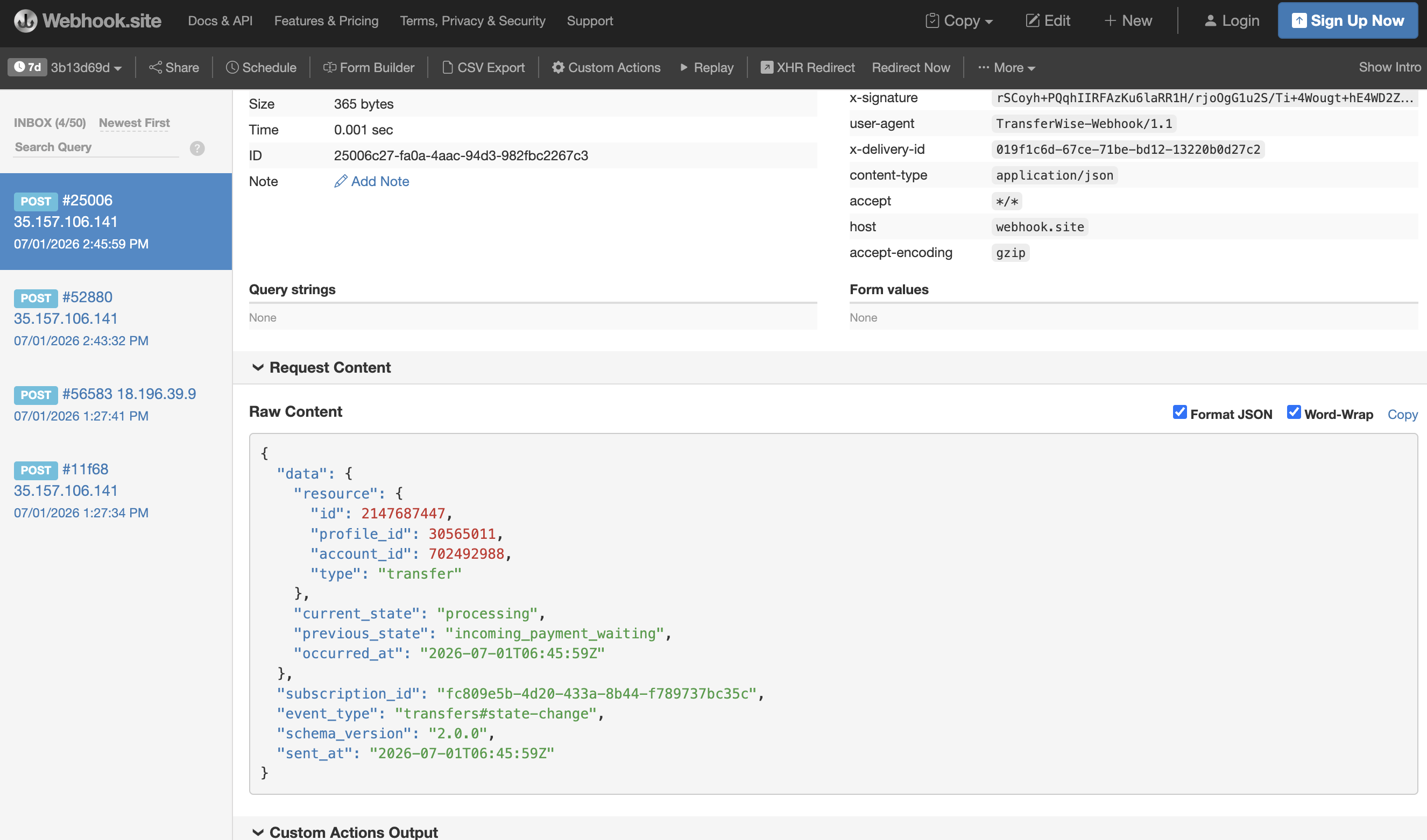
{
  "data": {
    "resource": {
      "id": 2147687447,
      "profile_id": 30565811,
      "account_id": 702492988,
      "type": "transfer"
    },
    "current_state": "processing",
    "previous_state": "incoming_payment_waiting",
    "occurred_at": "2026-07-01T06:45:45Z"
  },
  "event_type": "transfers#state-change",
  "schema_version": "2.0.0",
  "sent_at": "2026-07-01T06:45:45Z"
}
Step 6: Cross-checking against the Wise console UI
With the transfer in processing, I pulled up the same transaction in the Wise sandbox console to confirm every API value matched what a real user would see.
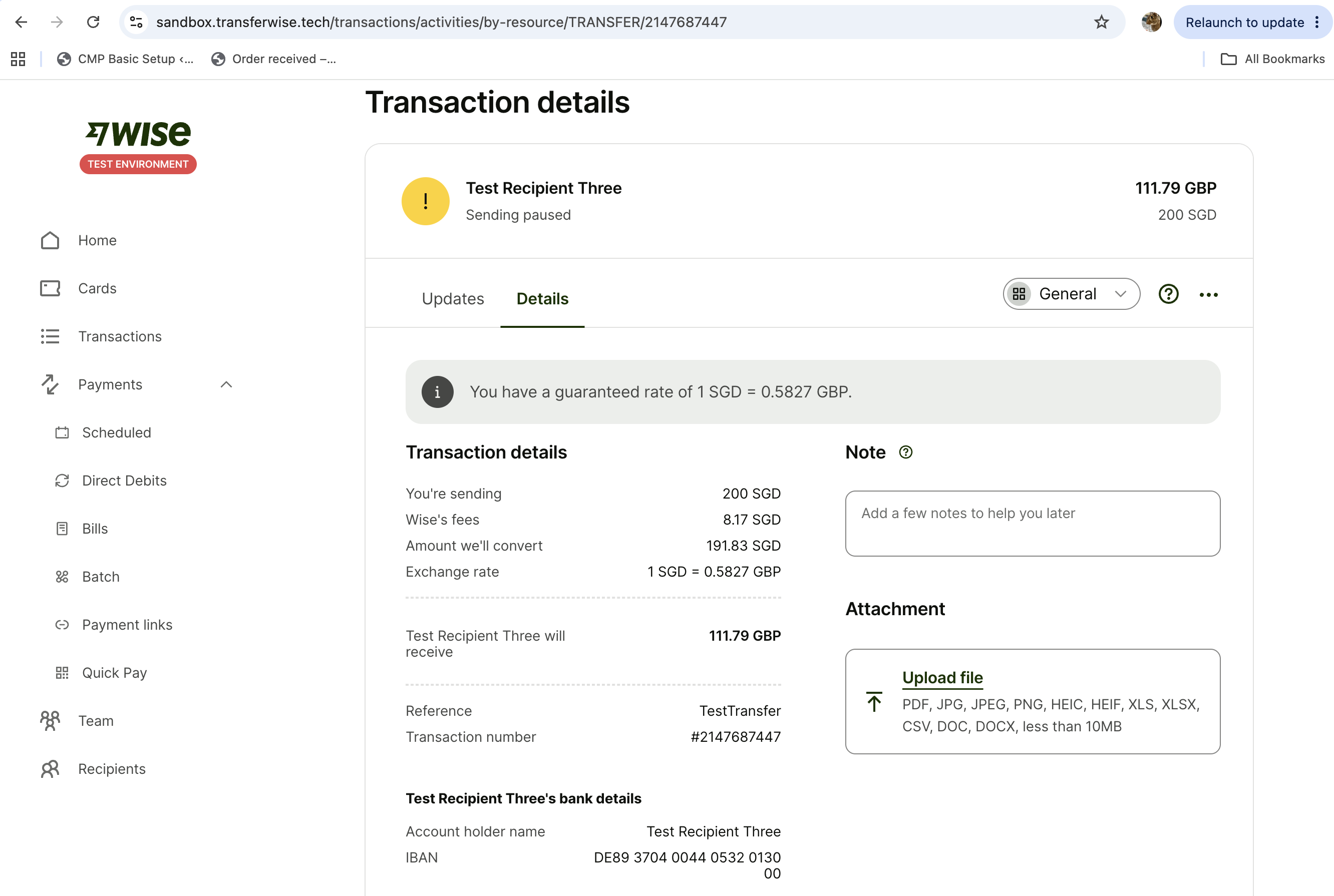
| UI field | Value shown | API source | Match |
|---|---|---|---|
| Transaction number | #2147687447 | POST /v1/transfers → id | ✓ |
| Recipient name | Test Recipient Three | GET /v1/accounts → accountHolderName | ✓ |
| Amount sending | 200 SGD | Quote sourceAmount | ✓ |
| Wise’s fees | 8.17 SGD | Quote paymentOptions[].fee.total | ⚠️ see below |
| Amount we’ll convert | 191.83 SGD | GET /v1/transfers → sourceValue | ✓ |
| Recipient receives | 111.79 GBP | GET /v1/transfers → targetValue | ✓ |
| Exchange rate | 1 SGD = 0.5827 GBP | Quote rate (0.582737), UI rounds to 4dp | ✓ |
Everything lines up cleanly – except the fee row. The quote’s paymentOptions[BALANCE].fee.total actually said 1.29 SGD, not 8.17 SGD. I flagged this row rather than quietly matching it, because it turned into the single most interesting finding of the whole exercise – reproduced three separate times, on two sandbox versions, on both business and personal profiles. The full investigation is in the next post.
Step 7: Trying to push the transfer to a terminal state
The UI showed the transfer as Pending. To see whether it could reach a terminal state, I used Wise’s sandbox-only simulation endpoints to try to force the next transitions.
Step 7a: Simulate funds_converted
GET /v1/simulation/transfers/{{transferId}}/funds_converted
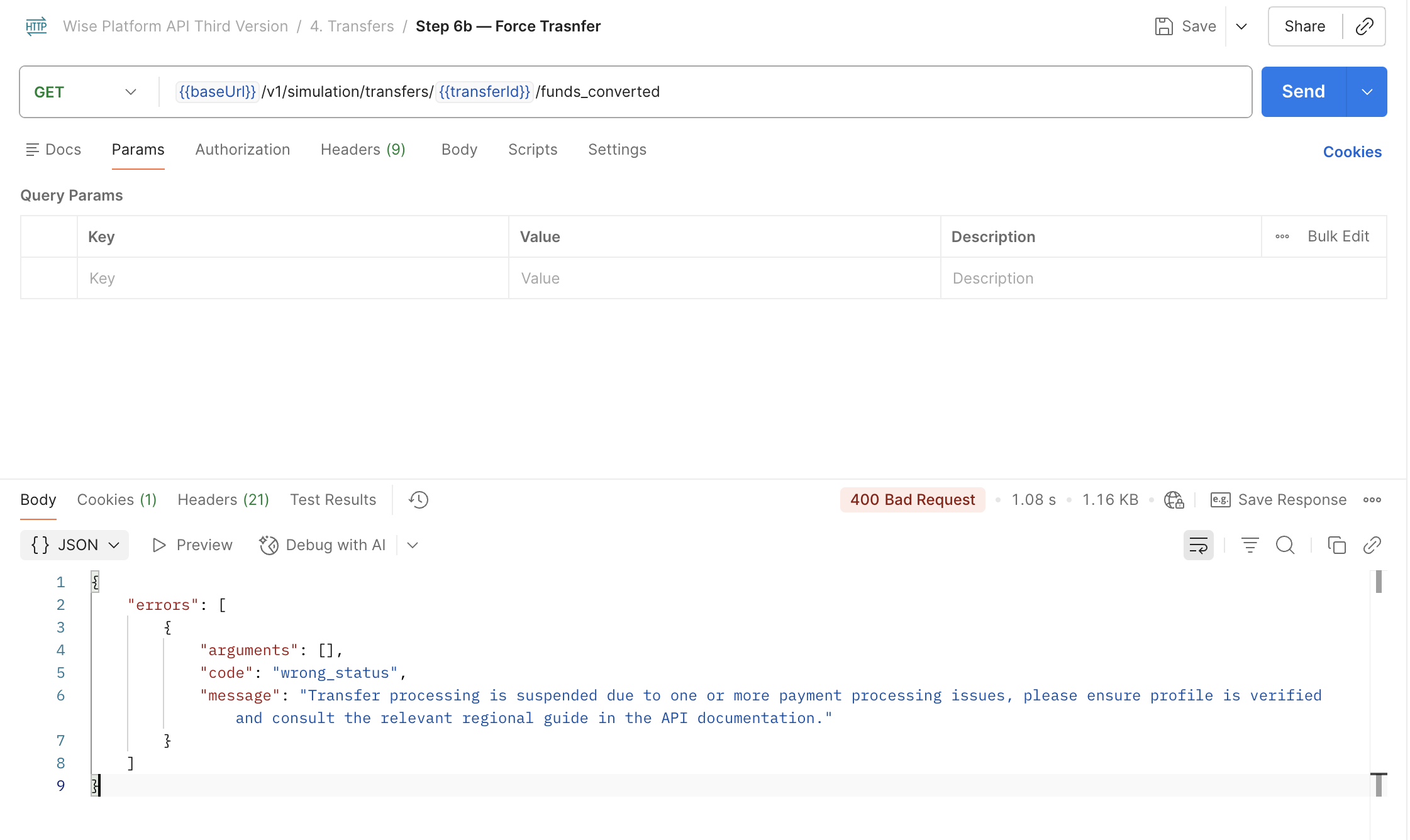
400 Bad Request
{
  "errors": [
    {
      "code": "wrong_status",
      "message": "Transfer processing is suspended due to one or more payment processing issues. please ensure profile is verified and consult the relevant regional guide in the API documentation."
    }
  ]
}
This is a real, functioning compliance gate showing up in a sandbox environment: the business profile used for this run wasn’t KYC-verified, and Wise’s simulation API enforces the same verification requirement sandbox-side that it would in production.
Step 7b: Simulate outgoing_payment_sent
GET /v1/simulation/transfers/{{transferId}}/outgoing_payment_sent
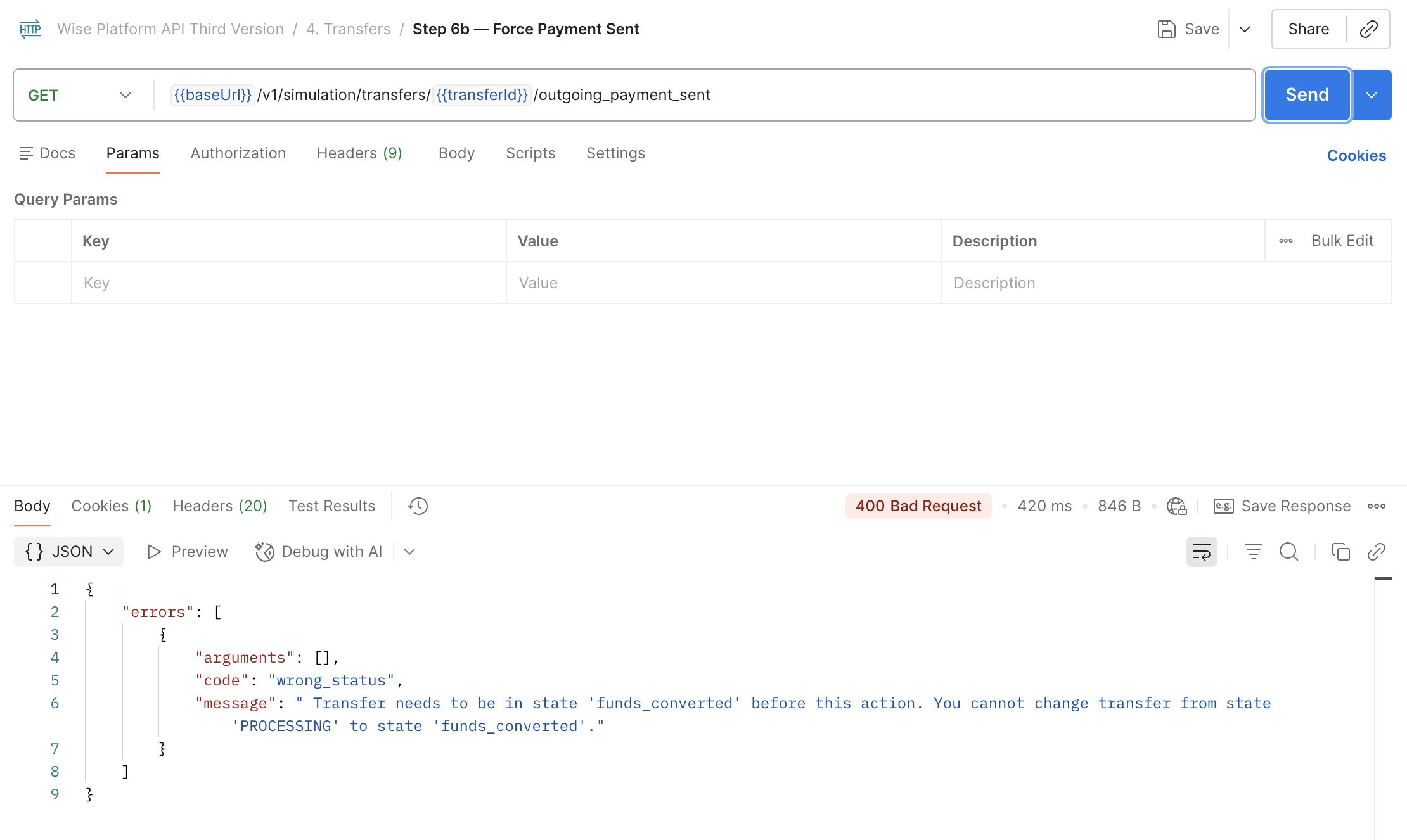
400 Bad Request
{
  "errors": [
    {
      "code": "wrong_status",
      "message": "Transfer needs to be in state 'funds_converted' before this action. You cannot change transfer from state 'PROCESSING' to state 'funds_converted'."
    }
  ]
}
The simulation state machine enforces strict sequencing – you cannot skip funds_converted on the way to outgoing_payment_sent, even in a test environment. Combined with the KYC block above, reaching a fully completed transfer in sandbox requires two separate conditions to both be satisfied: a verified profile, and calling every intermediate state in order. Miss either one and the simulation call fails with wrong_status – the same error code for two structurally different reasons.
Summary
| Step | API Call | Result |
|---|---|---|
| 1 | GET /v1/profiles | Business profile 30565011 captured |
| 2 | POST /v3/profiles/{id}/quotes | SGD→GBP quote created, rate 0.582737 locked |
| 3 | GET /v1/accounts?profile={id} | Existing GBP recipient 702492988 retrieved |
| 4 | POST /v1/transfers | Transfer 2147687447 created, incoming_payment_waiting |
| — | webhook | null → incoming_payment_waiting received |
| 5 | POST /v3/profiles/{id}/transfers/{id}/payments | Funded via BALANCE, COMPLETED |
| 5b | GET /v1/transfers/{id} | Status confirmed: processing |
| — | webhook | incoming_payment_waiting → processing received |
| 6 | Wise sandbox console | All API values confirmed in UI, except fee (flagged) |
| 7a | Simulate funds_converted | 400 – profile not KYC-verified |
| 7b | Simulate outgoing_payment_sent | 400 – wrong_status, sequence violated |
The transfer never reached a terminal state in this run – and that’s exactly what made it interesting. Getting blocked by a real KYC gate and a real state-machine constraint, inside a sandbox, told me more about how the system actually behaves under the hood than a clean happy-path run would have. The fee mismatch flagged in Step 6 turned into a genuine investigation, which is where the next post picks up.
Until next time, peace and love!