Why the Cloud Device API Can’t Be Tested Without Hardware
Table of contents
This closes out the series. It isn’t a scenario walkthrough like the previous four posts – it’s a documented negative result. Context: the architecture post (cloud vs. local tradeoff, who owns each part of the stack) and the mock terminal post (why Track A, the mock, exists as the alternative to begin with).
The finding, stated plainly
The Cloud Device API has a hard, structural requirement for an existing deviceId – there is no API call, test mode, or workaround that creates one out of thin air. This was confirmed three ways: by hitting the real endpoint and reading its error, by reading Adyen’s own architecture docs, and by researching every documented path to getting a deviceId at all. All three converge on the same answer: without a physical terminal or a phone running Adyen’s Payments Test app, this cloud path cannot be exercised beyond its auth/routing layer.
What was actually tried
GET /v1/merchants/{merchantAccount}/connectedDevices– the discovery endpoint, checking what’s already boarded. Confirmed nothing is.POST /v1/merchants/{merchantAccount}/devices/{deviceId}/sync(Payment - Sync) withdeviceIdleft blank, since there’s none to put there.
What came back
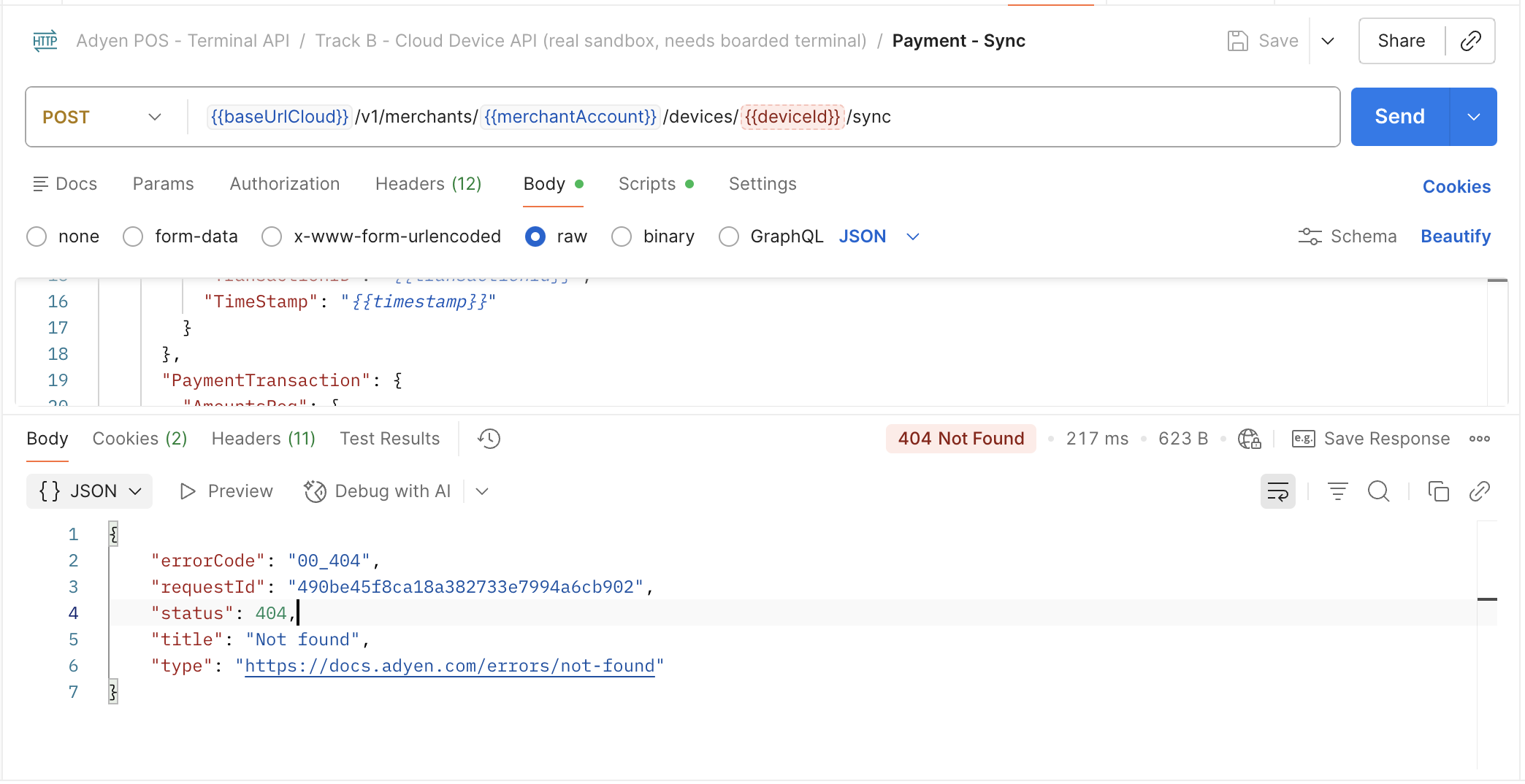
URL resolved to .../devices//sync – Postman visibly flags the missing deviceId in red as unresolved. Response: 404 Not Found in 217ms:
{
  "errorCode": "00_404",
  "requestId": "490be45f8ca18a382733e7994a6cb902",
  "status": 404,
  "title": "Not found",
  "type": "https://docs.adyen.com/errors/not-found"
}
Worth being precise about what this error does and doesn’t prove: this is a structured, well-formed Adyen error envelope – same shape (errorCode/status/title/type) as a bad-API-key 00_401 – which confirms the request genuinely reached Adyen’s platform and was handled by their real error-handling layer, not dropped or misrouted. But because deviceId was empty, the path itself was malformed (devices//sync, double slash) – this is a routing-level 404, not Adyen saying “that specific device doesn’t exist.” There’s no valid-but-nonexistent device ID available to trigger the more specific version of that error instead.
Why there’s no way around this
Confirmed by reading Adyen’s own docs, not assumed:
- Building a cloud integration – the whole model is “send Terminal API requests to our platform and it forwards them to cloud-connected payment terminals.” The architecture is defined around relaying to something that already exists and is already connected – there’s no concept of a request that also creates the thing it’s addressed to.
- No “create a device” endpoint exists. The closest thing,
generatePaymentsAppBoardingToken, is the middle step of a 3-step boarding flow (www.adyen.com/test/boarded→generatePaymentsAppBoardingToken→www.adyen.com/test/board) – calling it alone, without a real phone running Adyen’s Payments Test app completing the other two steps, produces nothing usable. - Both real paths to a
deviceIdrequire something that can actually process aPaymentRequest– capture a card, show a screen, respond. A device isn’t a database row; it’s an active endpoint. The two ways to get one: order physical hardware via the Management API (real terminals, “at least four business days” to arrive), or board an Android phone via the Payments Test app (free, immediate, but requires an actual Android device with NFC).
Best we can do is mock it — and we already have
The key reframe: only the cloud-specific transport is unreachable, not the payload. The SaleToPOIRequest/SaleToPOIResponse JSON body is identical whether it travels over local or cloud transport – cloud vs. local only changes how the message gets to a terminal, not what’s inside it. Track A has already fully exercised that shared payload contract, across the approved, reversal, and declined scenarios covered earlier in this series.
What Track A genuinely cannot stand in for, because it never touches Adyen’s real infrastructure, is the cloud-specific transport mechanics:
- The real
X-API-Keyauth handshake againstdevice-api-test.adyen.com - Adyen’s actual relay behavior (Cloud → real terminal → back)
- The sync (long-held connection, >150s timeout) vs. async (immediate
200 OK+ separate notification) delivery mechanics - What a genuine “device not found” error looks like for a valid but nonexistent device ID, versus the malformed-path 404 above
That gap only closes with a real device. Everything else about the cloud flow – the message shape, the decline logic, the field semantics – is already covered via Track A.
Test mode vs. real life
In real life, this problem never comes up for someone doing this professionally – by the time cloud integration testing starts, the merchant already has a deviceId from their terminal fleet, boarded via the normal ordering/assignment process ahead of go-live. The deviceId isn’t something generated for a test; it’s a byproduct of actual hardware existing and being provisioned.
In test mode, without hardware, this is a genuine hard wall – not a configuration mistake, not a missing role, not something fixable by trying harder in Postman. The only ways through it (order hardware, or board a phone via the Payments Test app) both require real-world setup outside the API itself.
Conclusion
The cloud path is fully documented at the request/response shape level, and this series has now confirmed exactly where its ceiling is and why. Track A plus this finding is the complete picture for the cloud-vs-local question, unless an Android phone becomes available to pursue genuine boarding later.
That closes the series: architecture → local mock setup → approved payment → reversal and insufficient balance → this post. If you’re coming at Adyen from the online checkout side instead of point-of-sale, Adyen Online Payments covers that flow.
Until next time, peace and love!