Declined Payment: Insufficient Balance
Table of contents
The second of two short unhappy-path posts, mirroring the approved payment walkthrough with one digit changed. Setup is already covered in the mock terminal post; not repeated here.
Objective
Trigger a declined payment via the mock’s amount-suffix convention and confirm the refusal-reason shape a POS would need to parse.
Request sent
Identical to the approved-payment request, only RequestedAmount changed to end in 124 (minor units):
"PaymentTransaction": {
  "AmountsReq": { "Currency": "{currency}", "RequestedAmount": 1.24 }
}
Actual result
200 OK, after the same PIN-entry step as an approved payment – the mock doesn’t know it’s “declining” until after PIN confirmation:
"Response": {
  "AdditionalResponse": "message=NOT_ENOUGH_BALANCE&refusalReason=210%20Not%20enough%20balance",
  "ErrorCondition": "Refusal",
  "Result": "Failure"
}
The rest of the payload (PaymentAcquirerData, PaymentInstrumentData.CardData with a fake masked PAN/maestro brand, SaleData.SaleTransactionID) is the same kind of static fixture content as the approved flow – see the approved-payment post’s appendix for the full proof.
Screenshots
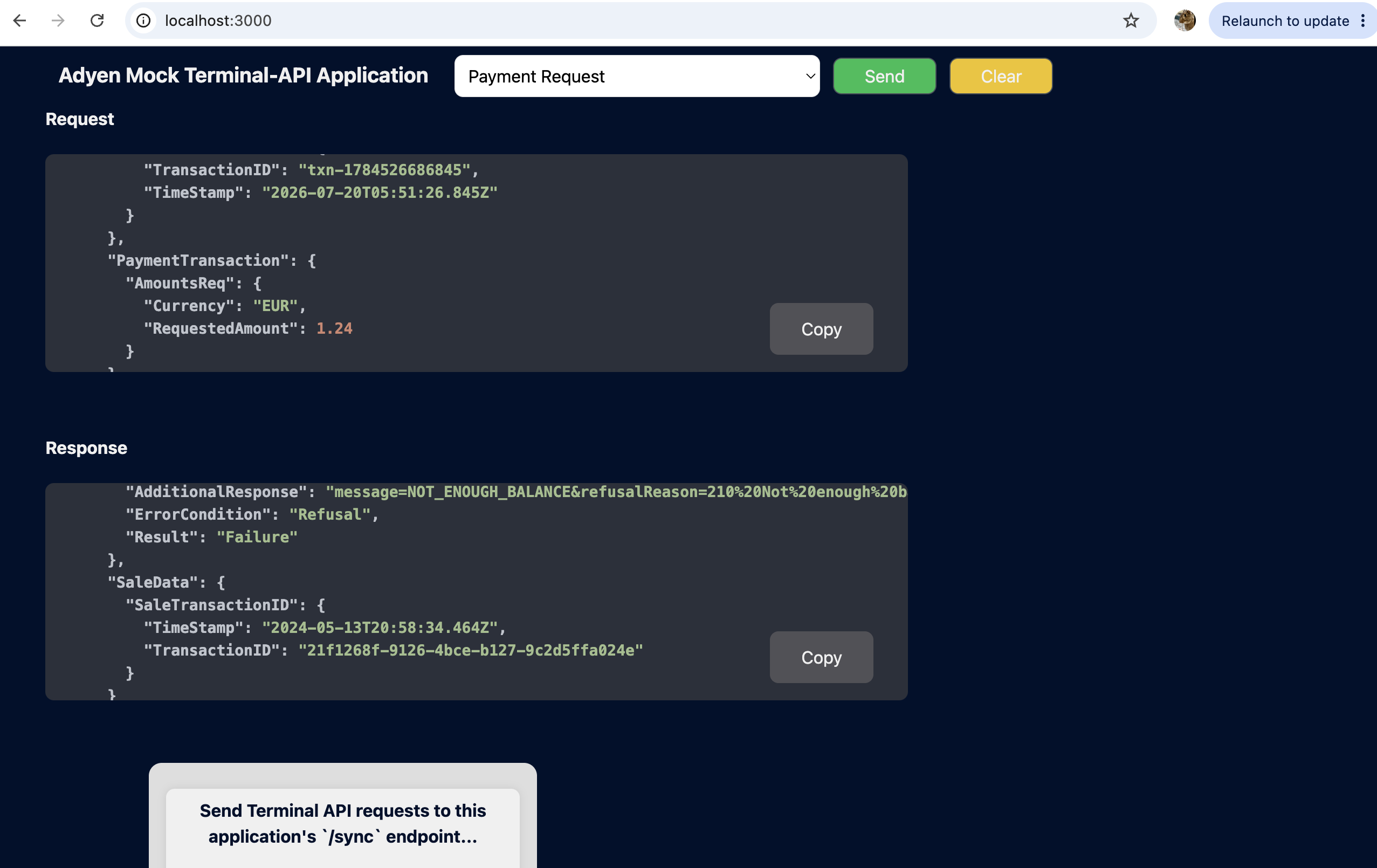
The mock terminal’s own Request/Response panel – RequestedAmount: 1.24 in the request, AdditionalResponse: message=NOT_ENOUGH_BALANCE&refusalReason=210 Not enough balance in the response.
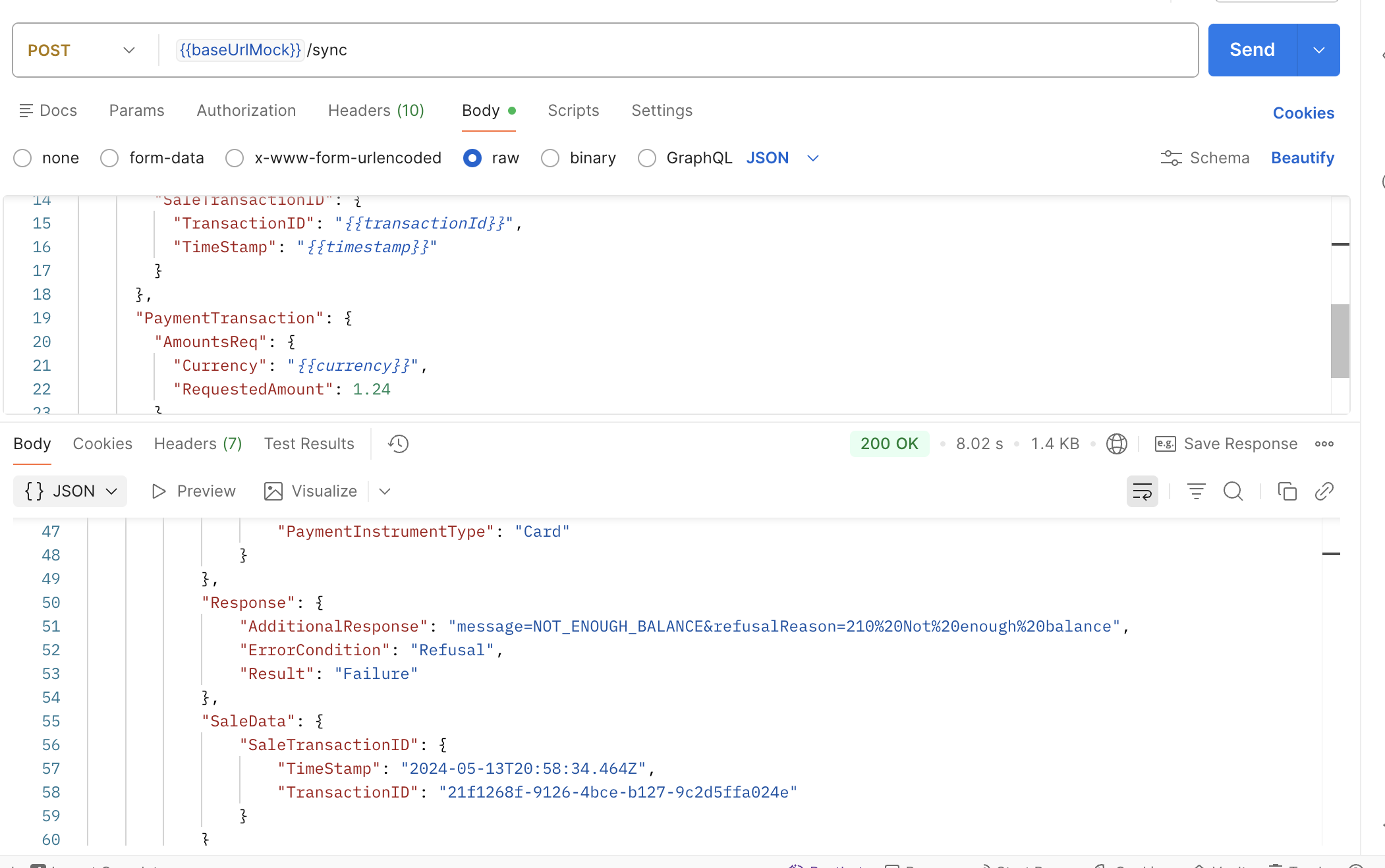
Postman: 200 OK, 8.02s (PIN-entry wait, same as any Payment request), same refusal payload.
Test mode vs. real life
The trigger mechanism is pure test convenience, not something real. In this mock, any amount ending in 124 (minor units) always declines with “not enough balance” – it has nothing to do with an actual card or balance; it’s a lookup table in the mock’s source. Adyen’s own physical test cards use a similar amount-suffix convention for the same reason: so decline paths can be exercised deliberately without needing a card that would genuinely decline.
In real life, this refusal originates from the card issuer, returned through the real authorisation network based on the cardholder’s actual available balance/credit – there’s no “magic number” that forces it; it’s a genuine outcome of a genuine authorisation attempt. What is real and worth trusting: the shape of the refusal – Result: "Failure", ErrorCondition: "Refusal", and an AdditionalResponse string carrying a message=/refusalReason= pair. That structure matches Adyen’s actual refusal-reason taxonomy, so this is a legitimate way to build and verify POS-side branching logic (check Response.Result, parse AdditionalResponse for the reason) before ever touching a real card.
Net takeaway: this test is solely for familiarization with how a decline looks over the API – it tells us nothing about real issuer decline behaviour, timing, or which real-world scenarios produce which refusal reasons. Useful for verifying error-handling code exists and works; not useful for anything beyond that.
See also
Reversal – the other short unhappy-path scenario in this series, reversing the approved payment instead of declining a new one.
Until next time, peace and love!