Fasting Insulin & HOMA-IR
Table of contents
Glucose numbers tell you how much sugar is in your blood. Insulin tells you how hard your body is working to keep it there. Fasting insulin and HOMA-IR (a score calculated from insulin and glucose) are the closest thing a standard blood test has to a measure of insulin sensitivity. Mine improved a lot between April and October, to the point where insulin dipped just below the lab’s range. This article covers what that means.
Snapshot
| April 2026 | October 2026 | |
|---|---|---|
| Fasting insulin | 6.2 mU/L | 2.0 mU/L (flagged low) |
| Lab range (insulin) | 2.6–24.9 mU/L | |
| HOMA-IR | 1.57 | 0.42 |
| Lab range (HOMA-IR) | below 3 = normal | |
| My doctor’s target | HOMA-IR below 2 | |
| Status | ✅ normal | ✅ very insulin-sensitive, ⚠️ insulin just below range |


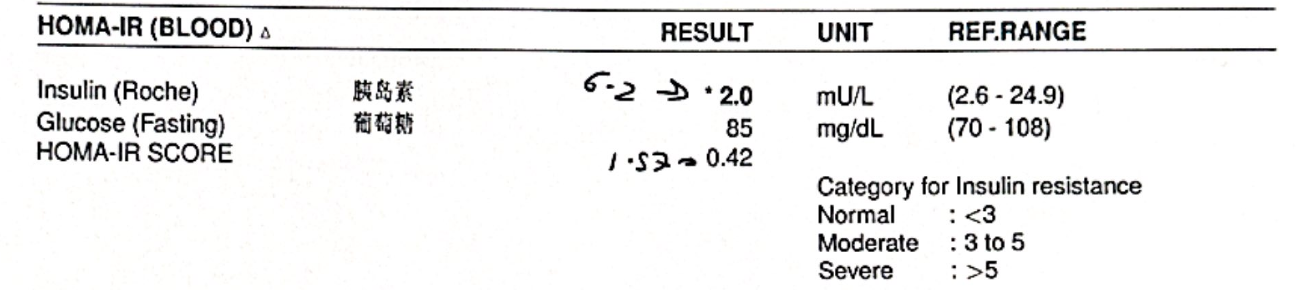
Here’s the HOMA-IR section of my October report, with my doctor’s handwritten April values next to the new ones:
What it is
Insulin is the hormone that moves glucose out of your blood and into your muscles and liver. When you’re fasting, your body only needs a small amount of it to keep glucose steady.
If your cells stop responding well to insulin (insulin resistance), your pancreas compensates by pumping out more. So in the early stages of insulin resistance, glucose can still look normal while fasting insulin is quietly climbing. That’s why insulin is a useful early warning.
HOMA-IR combines the two into one score:
HOMA-IR = fasting insulin (mU/L) × fasting glucose (mmol/L) ÷ 22.5
For me: 2.0 × 4.7 ÷ 22.5 = 0.42 in October, and 6.2 × 5.7 ÷ 22.5 = 1.57 in April. Lower means more insulin-sensitive. My lab’s categories are below 3 normal, 3–5 moderate insulin resistance, and above 5 severe; my doctor’s target for me is below 2.
What I’m aiming for
- HOMA-IR below 2, my doctor’s target, and ideally around 1 or lower.
- Fasting insulin inside the lab range (2.6–24.9), and on the lower side of it. For a lean, very active person, low-single-digit fasting insulin is normal.
April: fine, but not great
In April, HOMA-IR was 1.57: inside the normal range and under my doctor’s target. On its own that was reassuring. The concern was that it sat alongside a borderline fasting glucose (5.7) and HbA1c (5.7%), so it was worth improving rather than just “passing”.
Insulin resistance is the root of most of the problems in this series: it pushes up blood sugar, encourages fat storage around the organs, and is linked to higher triglycerides and heart risk over time.
Why October is better, and what probably helped
A HOMA-IR of 0.42 means my body needs very little insulin to keep my fasting glucose in a good place. What probably helped:
- Losing about 7 kg of fat, including almost half my visceral fat. Fat around the organs is one of the strongest drivers of insulin resistance.
- Training up to six times a week before my 11 October competition. Exercise makes muscle take up glucose with less insulin, and the effect lasts a day or two after each session.
- More protein and lower-GI carbs, like brown rice.
Why insulin is now a little low
A fasting insulin of 2.0 is just under the lab’s lower limit of 2.6. In my case, it’s most likely just a side effect of how lean and active I was at the time of the test: about 9.55% body fat, nine days after a weight cut for competition, after weeks of training almost every day. When you’re that insulin-sensitive, your body simply doesn’t need much insulin while fasting.
It is worth reading alongside my HbA1c, though. HbA1c went up (5.7 to 5.9) while insulin went down, so I’m asking my doctor whether that combination needs any follow-up, rather than assuming it’s fine.
What my glucose sensor adds
My two-week glucose sensor fills in what the fasting test can’t see (live data on my glucose tracking page):
- After meals, my glucose rises and usually returns to my starting level within about an hour. In people with insulin resistance, it typically stays up for two to three hours or more.
- After a spike, I often dip a little lower than where I started, to around 4.4–4.7 mmol/L. That’s consistent with a strong insulin response.
The sensor only measures glucose, not insulin, so it can’t prove insulin sensitivity on its own. But the curves fit the blood test.
What’s next
- Ask my doctor whether the low fasting insulin needs any follow-up, given the HbA1c result.
- Retest fasting insulin and HOMA-IR at my next screening, once I’m back at maintenance and not nine days after a weight cut, for a fairer comparison.
- Keep the training going once my elbow is healed.
This is my own personal data, shared for interest only. It’s not medical advice.
Until next time, peace and love!