HbA1c
Table of contents
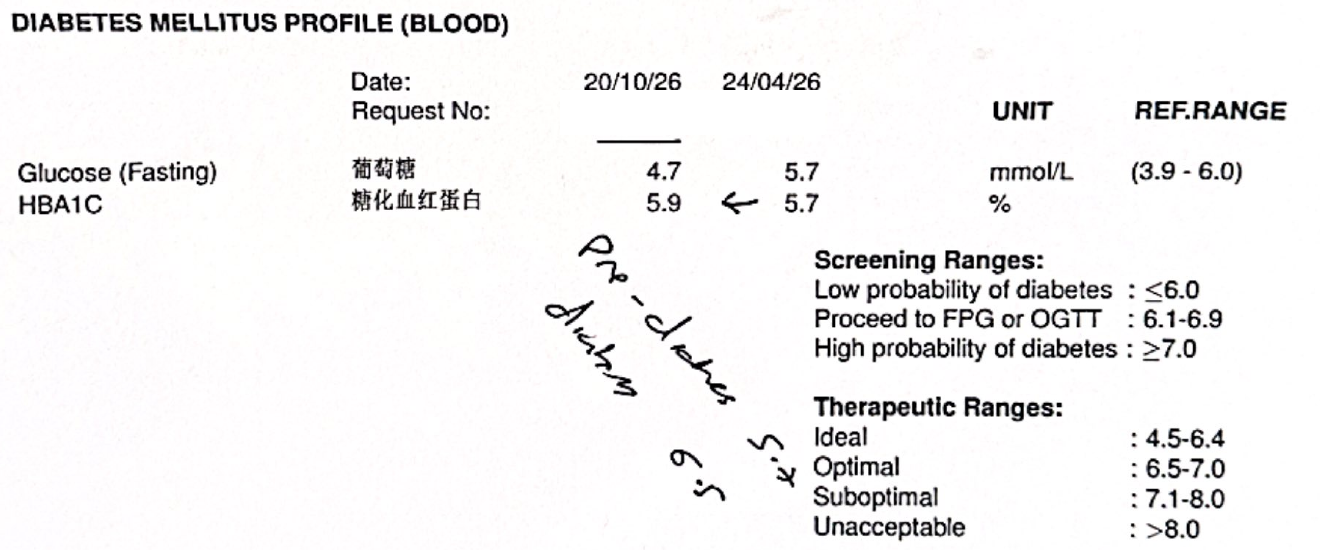
HbA1c is the one marker in my October screening that went the wrong way while everything around it got better. My fasting glucose dropped, my insulin sensitivity improved a lot, and yet HbA1c crept up from 5.7% to 5.9%. My doctor wrote “pre-diabetes” next to it. This article is me working through what that number actually means, why it might be out of step with the rest, and what I’m doing to find out.
Snapshot
| April 2026 | October 2026 | |
|---|---|---|
| HbA1c | 5.7% | 5.9% |
| Lab screening range | ≤6.0% “low probability of diabetes” | |
| ADA prediabetes range | 5.7–6.4% | |
| My target | below 5.7% | |
| Status | ⚠️ at the edge of prediabetes | ⚠️ inside the prediabetes range |

Here’s the section of my October report, with my doctor’s handwritten “pre-diabetes” note next to the result:
What it is
Glucose in your blood sticks to haemoglobin, the protein inside red blood cells. The more glucose there is, and the longer it’s around, the more of your haemoglobin ends up “sugar-coated” (glycated). HbA1c is the percentage of haemoglobin that’s glycated.
Red blood cells live for about three months, so HbA1c works like a rolling average of your blood sugar over the last two to three months, with the most recent few weeks counting the most. That’s why doctors like it: a single fasting glucose is a snapshot of one morning, while HbA1c covers the whole period, including the spikes after meals.
The common cut-offs, from the American Diabetes Association:
- Below 5.7%: normal
- 5.7–6.4%: prediabetes
- 6.5% and above: diabetes
My lab prints a slightly different screening range (≤6.0% “low probability of diabetes”), which is why my result isn’t flagged on the report even though it’s in the ADA prediabetes band.
What I’m aiming for
My target is below 5.7%, out of the prediabetes range. For my profile (34, lean, training BJJ most days, high-protein diet) there isn’t an obvious reason for HbA1c to be high, which is exactly why the 5.9 bugs me.
Why April was already a flag
In April, HbA1c was 5.7%, the very bottom of the prediabetes range, and my fasting glucose was 5.7 mmol/L as well, just over the cut-off for impaired fasting glucose. Two borderline glucose numbers together were enough for my doctor to note it.
The risk with prediabetes isn’t the number itself; it’s the direction. Left alone, it can drift towards type 2 diabetes over years, and higher average glucose is linked to heart disease, kidney damage and nerve damage over the long term. The good news is that at this stage it’s very responsive to diet, body fat and exercise.
Why October went up when everything else improved
Between April and October, I lost about 7 kg of fat, ate more protein and swapped to lower-GI carbs like brown rice, started vitamin D and zinc, and ramped BJJ up from weekly to six times a week before my 11 October competition. As a result:
- Fasting glucose fell from 5.7 to 4.7 mmol/L, clearly normal
- HOMA-IR fell from 1.57 to 0.42, meaning I’m very insulin-sensitive
So why would HbA1c go up? Some possibilities I’m raising with my doctor:
- Red blood cells, not blood sugar. HbA1c depends on how long your red cells live. Anything that changes red cell turnover can shift HbA1c either way, without any change in your actual blood sugar. In April I had mild anaemia, which had resolved by October, but my red cell count is still slightly low (more in the haemoglobin article). That’s a real reason HbA1c and glucose can disagree.
- The carb loading before my competition. HbA1c weighs the last few weeks most, and my draw was nine days after the comp. The refuelling around the weigh-in probably counted for something.
- Spikes after meals. A fasting test can’t see what happens after I eat. If my glucose spikes after certain meals, that adds to HbA1c even when my fasting numbers look perfect.
None of these is proven; they’re the questions I’m bringing back to my doctor.
What my glucose sensor is showing
To test the third point, I’m wearing a FreeStyle Libre glucose sensor for two weeks. My live readings are on my glucose tracking page.
So far (about six days):
- Average glucose: 5.7 mmol/L. That converts to an estimated HbA1c (called GMI) of about 5.8%, surprisingly close to the lab’s 5.9%. So the sensor isn’t clearly saying the lab got it wrong.
- After-meal spikes: most meals peak below 7.8 and come back within about an hour. The big ones were 8–9.3 mmol/L, after chicken nuggets, a burger, and a rice lunch after about eight tangerines as a snack.
- Small dips afterwards: I sometimes overshoot down to around 4.4–4.7 after a spike, which fits strong insulin sensitivity.
My early read: overall control looks good, but a handful of meals spike me, and those spikes are probably what’s nudging HbA1c up. The GMI needs at least 14 days of data to be reliable, though, so I’ll wait for the full sensor run before concluding anything.
What’s next
- Finish the two-week sensor run and compare the final average and GMI with the lab result.
- Ask my doctor whether an oral glucose tolerance test or fructosamine (a two-to-three-week marker that doesn’t depend on red cells) is worth doing to settle which number to trust.
- Keep going with the diet changes: fibre with meals, fewer refined carbs, and keeping an eye on the meals that spike me (nuggets and burgers, and a mountain of fruit before a rice meal).
- Retest HbA1c at the next screening.
This is my own personal data, shared for interest only. It’s not medical advice.
Until next time, peace and love!