ALT, Etoricoxib & My Neck
Table of contents
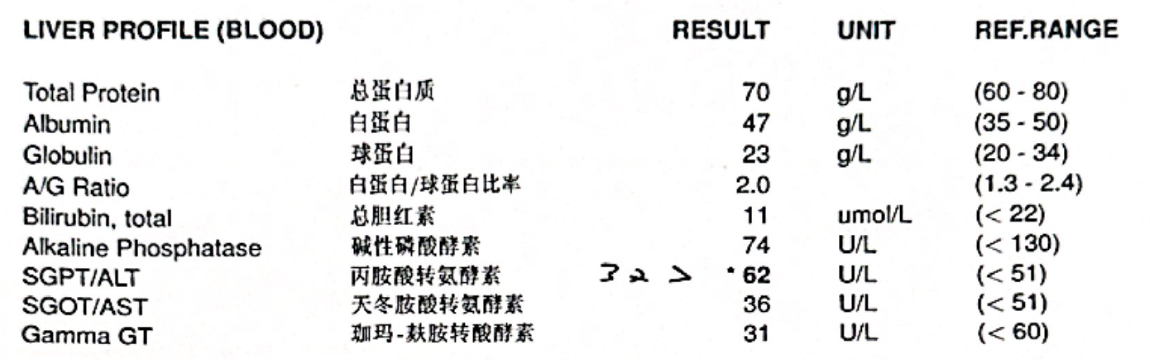
Almost everything in my October screening improved. The one new red flag was my liver: ALT went from 37 to 62, above the lab’s limit of 51. To explain why, I have to tell the story of my neck, because the most likely cause is the anti-inflammatory I was taking for it. This is the deep dive: what ALT is, what happened to my neck, what etoricoxib does, and what I’m doing next.
Snapshot
| Marker | April 2026 | October 2026 | Normal range | Status |
|---|---|---|---|---|
| ALT (alanine aminotransferase) | 37 U/L | 62 U/L | <51 | ⚠️ high |
| AST (aspartate aminotransferase) | 37 U/L | 36 U/L | <51 | ✅ |
| Gamma GT | 19 U/L | 31 U/L | <60 | ✅ |
| Bilirubin | 5 µmol/L | 11 µmol/L | <22 | ✅ |
| Alkaline phosphatase | 56 U/L | 74 U/L | <130 | ✅ |
| Albumin | 44 g/L | 47 g/L | 35–50 | ✅ |

This is the liver section of my October report. My doctor wrote my April value, “37 >”, next to the flagged ALT:
What ALT, AST and GGT are
These are enzymes, proteins that do chemical work inside cells. When cells are stressed or damaged, some of the enzyme leaks into the blood, so a higher blood level is a sign that something is irritating those cells.
- ALT lives mostly in the liver. It’s the most liver-specific of the three, so it’s the main “is the liver irritated?” marker.
- AST is in the liver too, but also in muscle. Hard training can raise AST on its own.
- GGT (gamma GT) rises with alcohol, bile duct problems and some medicines.
The pattern matters more than any single number. ALT up on its own, with AST, GGT, bilirubin and albumin all normal, usually means mild, temporary liver irritation. It doesn’t look like liver disease, a blocked bile duct or a liver that isn’t doing its job. Albumin and bilirubin are the “is the liver still working?” markers, and mine are fine.
What I’m aiming for
ALT back under 51, ideally closer to my April level of 37. As a lean athlete who rarely drinks, there’s no reason for my liver to be irritated long term. If it stays high once the likely triggers are gone, that’s when my doctor would want to look further.
The back story: my neck
How it started
My left trap had been tight on and off for months. I’d first felt it after posturing up against a head grip with bad technique, wrenching my head back. In late September 2026, an intense wrestler’s neck bridge and a session framing hard against a training partner’s chest set it off properly.
By 2 October it had escalated: severe pain radiating down my left arm, waking me at night. A GP put it down to inflammation, prescribed etoricoxib (Arcoxia) 120 mg, told me to rest for 48 hours, and gave me a referral letter in case it didn’t settle.
It didn’t. By 5 October I’d lost strength. My left forearm had a “dead spot” where I couldn’t resist it being turned palm-down with my elbow bent, and the next day I couldn’t lift my left arm overhead under my own power, even though it would go there if I helped it. Both of those muscles (biceps and the shoulder elevators) are run by the C5 nerve root in the neck. Weakness is a red flag, so I used the referral straight away.
What the MRI showed
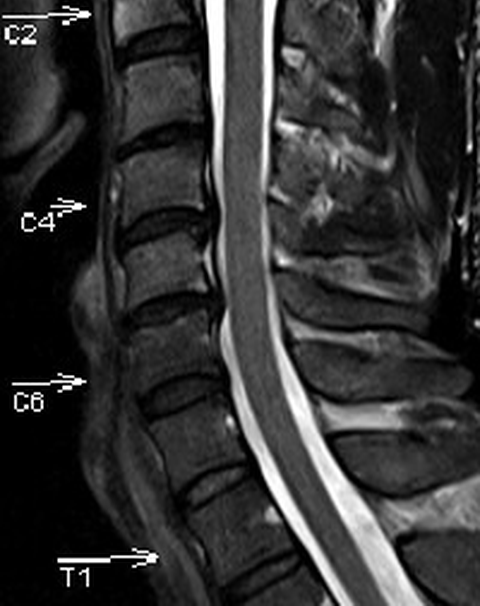
I had an MRI of my neck on 5 October. This is a side view of my neck. The bright band running down the middle is the fluid around the spinal cord; the radiographer’s arrows mark C2, C4, C6 and T1:
The radiologist’s report, in plain language:
- Disc herniations at four levels: C3/4, C4/5, C5/6 and C6/7. The discs bulge backwards and press into the sac that holds the spinal cord.
- Bone spurs (osteophytes) from C2 to C7, a sign of long-standing wear rather than one fresh injury.
- The spinal canal is narrowed at C4/5 and C5/6, and the discs touch and press on the cord there.
- The cord itself is normal: normal size, and no signal change inside it, so no sign of cord damage.
- The nerve-root exits (foramina) are narrowed, worst on the right at C3/4 and on both sides at C4/5 and C5/6. That’s where the C5 and C6 nerve roots leave the spine, which matches my left-arm weakness.
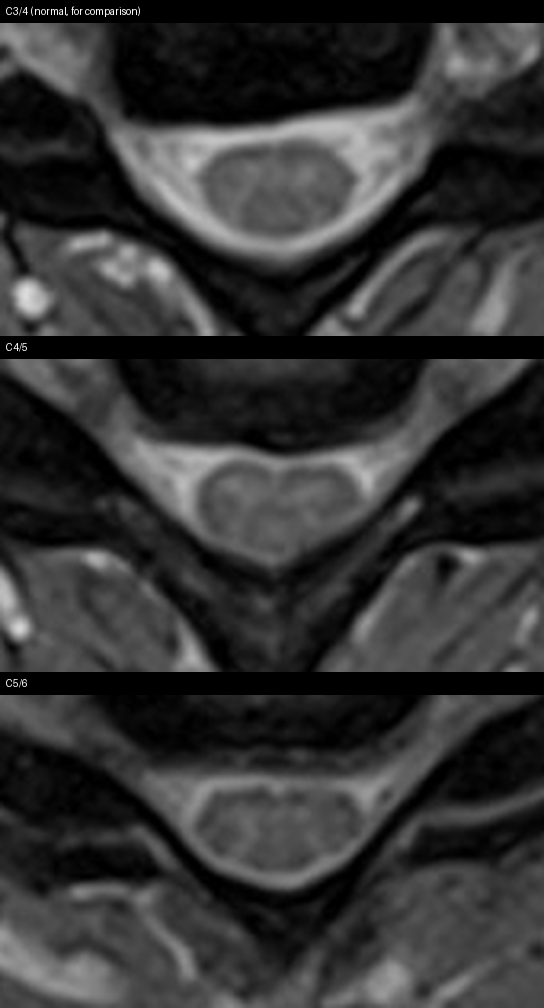
These are cross-sections at three levels. At C3/4 the cord is round with a full ring of bright fluid around it. At C4/5 the front of the cord is dented, and at C5/6 it’s flattened front to back where the disc presses on it:
What the specialists said
- The spine surgeon (6 October) diagnosed cervical disc prolapse at C4/5 and C5/6. He said the findings weren’t acute (they looked months old), and his main concern was the loss of strength. He advised stopping all training and referred me to physio. On my competition five days later, his advice was “be careful”. It wasn’t a hard no, but he didn’t seem keen.
- My physio read it as “acute on chronic”: old disc herniations, probably helped along by years of rugby league tackling and now wrestling and BJJ, that had recently become inflamed. His view was that I could compete if I had no arm pain or stingers, managing the risk.
- An orthopaedic sports doctor (20 October) gave me a second opinion, and referred me for structured physio for the neck and my elbow. Between the neck and the elbow, I’m off training from 11 October until 20 November.
The surgeon prescribed a standard nerve-pain regimen on 6 October:
- Etoricoxib (Arcoxia) 120 mg once a day for 5 days, then as needed
- Pregabalin (Lyrica) for nerve pain
- Eperisone (Myonal), a muscle relaxant
- Mecobalamin (Methycobal), a form of vitamin B12, for nerve support. This is also why my B12 came back slightly high.
- Esomeprazole (Nexium) to protect my stomach while on an NSAID
- An esflurbiprofen patch, a topical anti-inflammatory
My strength started coming back within a day of starting the medication, and I competed on 11 October. That’s where I re-injured my right elbow in an armbar, which is a separate story.
What etoricoxib is
Etoricoxib (brand name Arcoxia) is a COX-2 inhibitor, a type of NSAID (non-steroidal anti-inflammatory drug), in the same family as ibuprofen and naproxen. It blocks COX-2, an enzyme the body uses to make inflammatory signals, so it reduces pain and swelling. Because it targets COX-2 more selectively than ibuprofen, it’s a bit easier on the stomach, though I was still given esomeprazole alongside it. 120 mg is the higher dose, normally used for short courses of acute pain.
The liver link: like most NSAIDs, etoricoxib can raise liver enzymes, ALT in particular. The prescribing information lists raised ALT and AST as a known side effect, usually mild and reversible once you stop. It’s one of the more common reasons a doctor rechecks liver bloods in someone on a longer NSAID course.
My timeline:
| Date | What happened |
|---|---|
| 2 Oct | Etoricoxib 120 mg started (GP) |
| 6–7 Oct | New prescription from the spine surgeon; 5-day course 7–11 Oct |
| 11 Oct | Competition (last regular dose around here) |
| ~12 Oct | Stopped |
| 20 Oct | Blood test, ALT 62 |
So I took etoricoxib 120 mg for about ten days, ending roughly a week before the blood test. That’s close enough for the effect to still show.
What else probably pushed ALT up
Etoricoxib is the most likely cause, but it probably wasn’t the only one:
- Training load. I’d been training BJJ up to six times a week in the run-up to the competition. Very hard exercise can raise liver enzymes for days afterwards. That usually shows up more in AST, though, and mine was normal.
- The weight cut. I cut to 63.6 kg for the 65 kg division. Rapid weight loss and low energy intake can briefly stress the liver.
- The competition itself, and the elbow injury. Hard matches and a hyperextended elbow nine days before the draw mean muscle damage and inflammation in the background.
- The other medicines. Pregabalin and eperisone rarely affect liver enzymes, but they were in the mix too.
- High protein. Probably not a cause on its own (it’s more of a kidney and urea story; see Kidney Function), but it’s part of the context.
Why I’m not panicking
- It’s only ALT. AST, GGT, bilirubin, alkaline phosphatase and albumin are all normal. That pattern looks like mild irritation, not liver damage.
- 62 is a mild rise. It’s about 1.2 times the upper limit. Doctors generally start worrying about NSAID liver injury at around three times the upper limit, or when bilirubin goes up too.
- April was normal (37). This isn’t a long-standing problem.
- There’s an obvious, temporary trigger that has already stopped.
What’s next
- Repeat liver panel in 4–6 weeks. To give a clean read, I’ll go:
- off all NSAIDs (no etoricoxib, no ibuprofen, no anti-inflammatory patches) for the weeks before
- with no hard training in the 48–72 hours before the draw
- with no alcohol in the days before
- If ALT is back near 37: it was almost certainly the medication and the comp period.
- If it’s still high: my doctor will want to look further, for example with a liver ultrasound and checks for other causes such as fatty liver or viral hepatitis.
- Use NSAIDs sparingly from now on. With my neck, it would be easy to reach for anti-inflammatories every time it flares. Between this and my kidneys (see Kidney Function), I’d rather manage the neck with physio and load management, and keep NSAIDs for short, necessary courses.
- Neck: physio continues, with no neck-loading positions for now. The bigger question I’m working through with my doctors is which positions in BJJ and wrestling I should avoid for good, given that the discs are touching my spinal cord.
This is my own personal data, shared for interest only. It’s not medical advice.
Until next time, peace and love!