Haemoglobin & Red Cells
Table of contents
In April my blood count came back slightly low: a mild anaemia. By October, haemoglobin and haematocrit were back in range, and the red cell count was nearly there. This article covers what these numbers mean, why April probably wasn’t the usual iron problem, and what I’m still keeping an eye on.
Snapshot
| Marker | April 2026 | October 2026 | Normal range | Status |
|---|---|---|---|---|
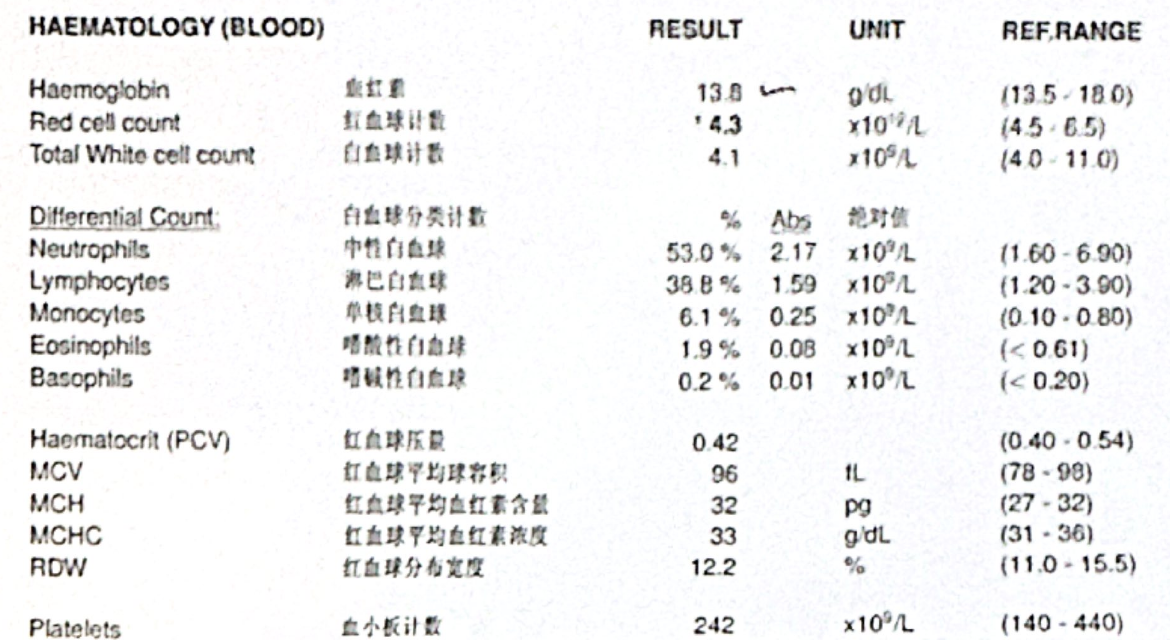
| Haemoglobin | 12.4 g/dL | 13.8 g/dL | 13.5–18.0 | ✅ back in range |
| Red cell count | 4.0 ×10¹²/L | 4.3 ×10¹²/L | 4.5–6.5 | ⚠️ better, still slightly low |
| Haematocrit | 0.38 | 0.42 | 0.40–0.54 | ✅ back in range |
| Ferritin (iron stores) | 322 µg/L | 339 µg/L | 30–400 | ✅ high-normal both times |



Here’s the October haematology section from my report. The arrow next to haemoglobin is my doctor’s handwriting, marking the improvement:
What these markers are
- Haemoglobin is the protein inside red blood cells that carries oxygen from the lungs to the muscles. It’s the main number used to define anaemia.
- Red cell count is how many red blood cells there are per litre of blood.
- Haematocrit is the share of the blood’s volume taken up by red cells. 0.42 means 42%.
- MCV (mean cell volume) is the average size of a red cell. It’s a useful clue: iron deficiency usually makes red cells small, while B12 or folate deficiency makes them large. Mine were normal-sized both times (94 and 96 fL).
- Ferritin is the body’s iron store. Low ferritin is the classic sign of iron-deficiency anaemia.
What I’m aiming for
For an adult man, the lab’s normal range is a haemoglobin of 13.5–18.0 g/dL. My target is simply to stay inside the ranges, ideally with some margin rather than sitting right on the lower edge. For a combat-sport athlete, oxygen-carrying capacity directly affects how long I can keep up a hard pace on the mats.
Why April was a problem
With haemoglobin at 12.4, red cells at 4.0 and haematocrit at 0.38, all three were below range: a mild anaemia. It wasn’t dramatic, but it’s the kind of thing that can show up as feeling flat, getting out of breath sooner, or recovering more slowly between rounds.
What made it interesting was what wasn’t wrong:
- Iron stores were fine. Ferritin was 322, high-normal, and iron saturation was 25% (in range). That’s not what iron deficiency looks like.
- The red cells were normal-sized (MCV 94) and the blood film said “normochromic, normocytic”, meaning normal colour and size.
So the usual “eat more iron” answer didn’t fit. One common explanation in people who train a lot is “sports anaemia”. Regular hard training expands blood plasma volume, which dilutes the red cells, so the concentration looks low even though the total amount of red cells is fine. Hard training can also nudge ferritin upwards, because ferritin rises with inflammation. That’s probably what was going on, but it’s my reading of the numbers, not a diagnosis.
Left unchecked, a real anaemia would matter because it means less oxygen delivery: more fatigue, poorer endurance, and in more serious cases strain on the heart. That’s why it was worth retesting rather than ignoring.
Why October is better
By October, haemoglobin was 13.8 and haematocrit 0.42, both back in range. Red cells rose from 4.0 to 4.3. What probably helped:
- More protein. I increased my protein intake between April and October. Building new red cells needs protein, along with iron, B12 and folate.
- Folate and B12 went up. Folate rose from 15.1 to 30.9 and B12 from 293 to 590. Both are needed to make red cells (more in the B12 & folate article).
- Zinc was corrected. My zinc was low in April and I supplemented 50 mg a day from then. Zinc plays a part in red cell production, so fixing a deficiency probably didn’t hurt (see the zinc article).
- The body adapted to training. My BJJ volume went from weekly to 2–3× a week, then up to 6× a week before my competition on 11 October. Over months the body makes more red cells to match the bigger plasma volume, so the dilution effect can even out.
I can’t say which of these mattered most. It’s probably a combination.
What’s next
- Red cell count is still slightly low (4.3 vs 4.5). Haemoglobin and haematocrit are normal now, so it’s not a concern on its own, but I’ll recheck it at my next full blood count.
- Ferritin stays high-normal (339). I’m not taking iron, and I won’t start without a reason, because extra iron isn’t harmless when stores are already full.
- My white cell count is also sitting right at the bottom edge of its range (4.1, range 4.0–11.0), the same as April. It’s in range, but it’s something else to look at next time.
This is my own personal data, shared for interest only. It’s not medical advice.
Until next time, peace and love!