hs-CRP
Table of contents
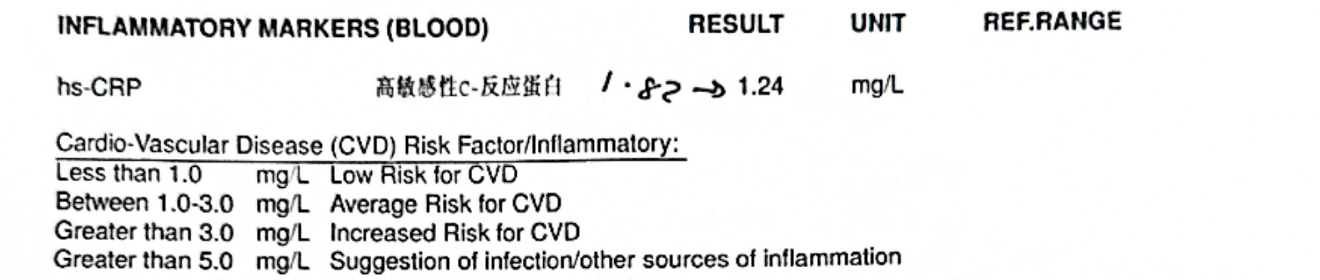
hs-CRP is a measure of low-level inflammation in the body. It’s tested alongside cholesterol because ongoing inflammation also plays a part in heart disease. Mine improved between April and October 2026, but it’s still not under my target of 1. My October blood draw came at a messy time, with a competition, a fresh elbow injury and a neck injury all in the weeks before, which makes this number harder to read.
Snapshot
| April 2026 | October 2026 | Low-risk band | My target | |
|---|---|---|---|---|
| hs-CRP | 1.82 mg/L | 1.24 mg/L | <1.0 | <1 |
| Status | ⚠️ Average-risk band | ⚠️ Better, still average-risk band |

From my October report, with the April value written in by my doctor and the lab’s risk bands underneath:
What it is
CRP (C-reactive protein) is made by the liver when there’s inflammation anywhere in the body. During an infection or after an injury, it can jump into the tens or hundreds.
The high-sensitivity (hs) version measures very low levels, the 0–5 mg/L zone. At those levels it isn’t picking up an infection; it’s picking up background, low-grade inflammation. Persistent low-grade inflammation is linked with plaque build-up in the arteries, which is why the lab reports it as a heart-disease risk factor:
- Under 1.0 mg/L: low risk
- 1.0–3.0: average risk
- Over 3.0: increased risk
- Over 5.0: suggests an infection or another source of inflammation, so the result can’t be read as a heart-risk number
What I’m aiming for
Under 1.0 mg/L, the low-risk band. A lean, fit 34-year-old with good lipids would normally sit there.
The catch is that hs-CRP is very sensitive to what’s going on in your body right now: a cold, a hard training week, a muscle strain or an injury can all push it up for days to weeks. One reading isn’t a verdict. Two readings at least a couple of weeks apart, taken when you’re well and not injured, are more meaningful.
Why April was a problem
At 1.82 mg/L, April was in the “average risk” band. Taken alone that’s not alarming, but April also had LDL above its limit, ApoB above target and more fat around my trunk. A higher hs-CRP alongside those is a slightly worse combination than any one of them alone.
I don’t have notes on what was happening with training or illness just before the April test, so I can’t say how much of the 1.82 was background inflammation and how much was temporary.
Why October is better (but not there yet)
hs-CRP dropped to 1.24 mg/L. What probably helped:
- Much less body fat. Fat tissue, especially visceral fat around the organs, releases inflammatory signals. My body fat went from 19.3% to 9.55% and visceral fat almost halved.
- Better lipids and more training overall.
So why isn’t it under 1? There are a few strong candidates around the October draw, and I can’t separate them:
- Competition training. In the weeks before my BJJ competition on 11 October, I was training 6 times a week. Hard training causes muscle damage and short-term inflammation.
- My elbow injury. I re-injured my right elbow (an armbar hyperextension) at the competition on 11 October, 9 days before the blood test. A fresh soft-tissue injury can easily keep CRP up for a while.
- My neck. I was diagnosed with cervical disc herniations in early October, and still had symptoms around the draw.
- The weight cut and post-competition recovery put extra stress on the body.
There’s also one factor pushing the other way: I was on etoricoxib, an anti-inflammatory, from about 2 to 12 October for my neck. It had stopped about a week before the draw, so its effect had probably worn off, but I can’t rule it out completely. (Etoricoxib is covered properly in the ALT article.)
Given all that, 1.24 is probably higher than my true baseline. But until it’s retested at a calmer time, that’s a guess.
What’s next
- Retest hs-CRP when I’m recovered: elbow and neck settled, no competition prep, no hard sessions in the 48–72 hours before, and no recent cold.
- If it’s still over 1 then, it’s worth a conversation with my doctor about other sources of inflammation.
This is my own personal data, shared for interest only. It’s not medical advice.
Until next time, peace and love!